




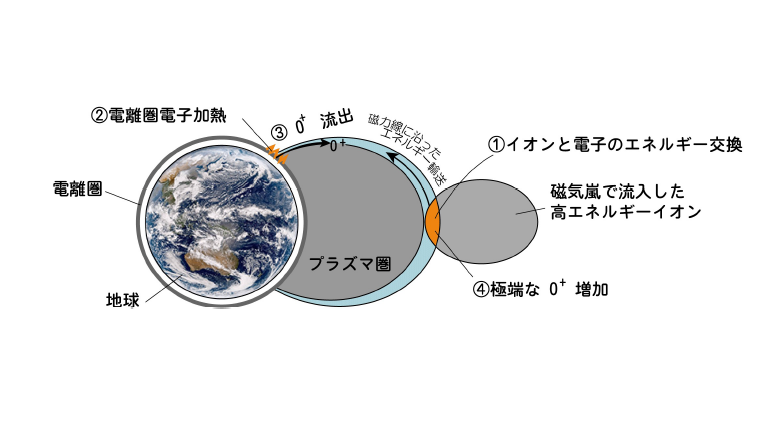
Professor Yoshiya Kasahara of the Emerging Media Initiative / Advanced Research Center for Space Science and Technology, Kanazawa University, together with a research group including associate professor (special appointment) Yuki Obana of the International Research Center for Space and Planetary Environmental Science (i-SPES), Kyushu University, has discovered for the first time worldwide that oxygen ions (O+) (*2) abnormally increase in near‑Earth space (the inner magnetosphere) during an extreme geomagnetic storm (*1). This achievement was made possible by analyzing the extreme geomagnetic storm that occurred in May 2024 using the collaborative measurement data from a ground‑based magnetometer network centered in New Zealand and the Exploration of energization and Radiation in Geospace "Arase" (ERG) satellite (*3). The results suggest the existence of a new mechanism in which extreme geomagnetic storms transport large amounts of atmospheric O+ into geospace.
These findings significantly advance our understanding of the near‑Earth space environment during extreme geomagnetic storms and are expected to contribute to space weather research related to satellite malfunctions and variations in high‑energy particle environments.
This research was published on May 23, 2026 (local time) in the international academic journal "Earth, Planets and Space" published by Springer Nature.
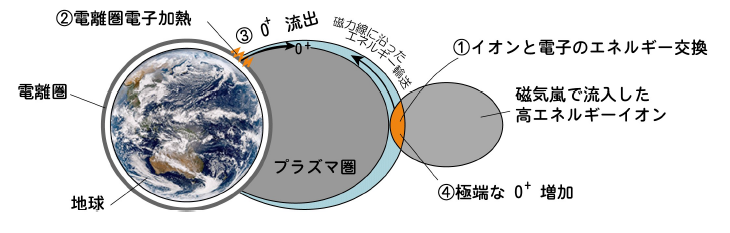
Figure: Extreme geomagnetic storm (main phase) in May 2024 (Earth image courtesy of the Japan Meteorological Agency)
*1 Magnetic Storm
A phenomenon in which the solar wind intensifies due to explosive events on the Sun, causing major disturbances in the near‑Earth space environment. Strong magnetic storms can produce low‑latitude auroras and may lead to satellite malfunctions or communication disruptions.
*2 Oxygen Ion (O+)
In the Earth’s upper atmosphere, oxygen atoms are ionized by solar ultraviolet radiation, producing O+. O+ is a heavy ion with a mass 16 times that of hydrogen ions and has a significant impact on waves and high‑energy particle environments in the magnetosphere.
*3 Exploration of energization and Radiation in Geospace "Arase" (ERG) satellite
A scientific satellite launched by JAXA in 2016. It observes plasma, waves, and high‑energy particles in near‑Earth space.
Click here to see the press release【Japanese only】
Journal: Earth, Planets and Space
Researcher Information :Yoshiya Kasahara
Related Information
Emerging Media Initiative, Kanazawa University
 PAGE TOP