



*****The following content was written by the author(s) of the paper.*****
Kanazawa University, Japan – Researchers led by Associate Prof. Md. Shahiduzzaman and Prof. Tetsuya Taima in collaboration with Prof. Katsuhiro Maeda and Prof. Hiroshi Hasegawa developed a one-step recycling method for flexible perovskite solar cells. The technology enables highly efficient recovery of toxic Pb (99.7%) and valuable metals including Au and In from end-of-life devices. This environmentally responsible approach reduces environmental risks, conserves valuable resources and supports sustainable commercialization of next-generation perovskite solar energy technologies.
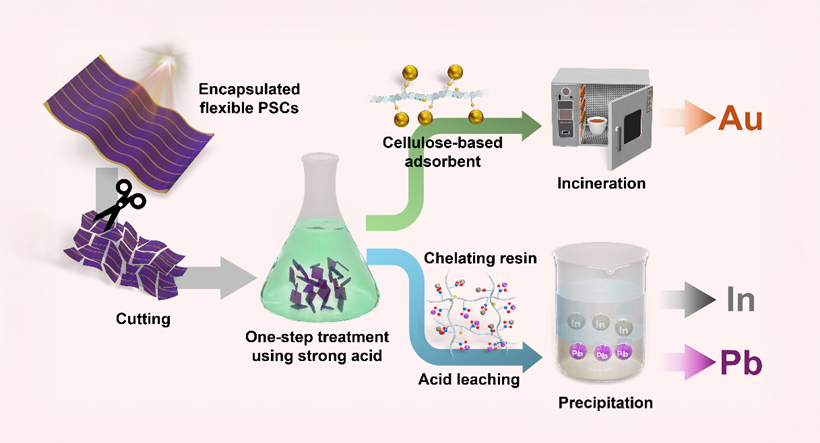
Perovskite solar cells (PSCs) are attracting worldwide attention as next-generation photovoltaic technologies because of their high efficiency, lightweight design, flexibility, and potential for low-cost manufacturing. These unique features make them promising candidates for applications ranging from wearable electronics and portable power sources to building-integrated photovoltaics. As commercialization approaches, however, the management of end-of-life devices has become an increasingly important challenge. Unlike conventional silicon solar cells, Pb-containing PSCs achieve exceptional photovoltaic performance. However, their reliance on toxic Pb raises environmental concerns if end-of-life devices are not properly managed and recycled. PSCs also contain valuable metals such as gold (Au) and indium (In), which are critical resources for modern electronic and energy technologies. Therefore, developing effective recycling technologies is essential to minimize environmental risks while promoting sustainable resource utilization. To address this challenge, researchers at Kanazawa University led by Associate Prof. Md. Shahiduzzaman and Prof. Tetsuya Taima in collaboration with Prof. Katsuhiro Maeda and Prof. Hiroshi Hasegawa developed a one-step recycling technology for flexible PSCs. The method combines low-concentration acid treatment with selective adsorption and separation processes to efficiently recover toxic Pb together with valuable metals from discarded devices.
"We wanted to develop a practical recycling strategy that not only recovers toxic Pb but also captures valuable metals including Au and In from end-of-life flexible PSCs and modules," explains Md. Shahiduzzaman, Associate Professor at Kanazawa University and corresponding author of the study. Using the new approach, the research team achieved highly efficient recovery of Pb (99.7%) together with Au and In from end-of-life flexible PSCs. The process minimizes waste generation while enabling effective separation and collection of valuable materials. The process is compatible with both fresh and degraded devices, making it suitable for practical recycling applications. Using the new approach, the researchers achieved recovery efficiencies of 91.6% for Au, 99.7% for Pb, and 100% for In from solution. The process is compatible with both fresh and degraded devices and minimizes secondary waste generation, making it suitable for future large-scale recycling applications.
“Recycling technologies will become increasingly important as PSCs move closer to large-scale commercialization,” says Professor Tetsuya Taima. Our work provides a pathway toward a circular economy for next-generation perovskite solar energy technologies. The researchers believe that integrating efficient recycling systems with future PSC manufacturing will help reduce environmental risks, conserve critical resources and accelerate the sustainable deployment of perovskite solar energy worldwide. The study was published in "ACS Sustainable Chemistry & Engineering".
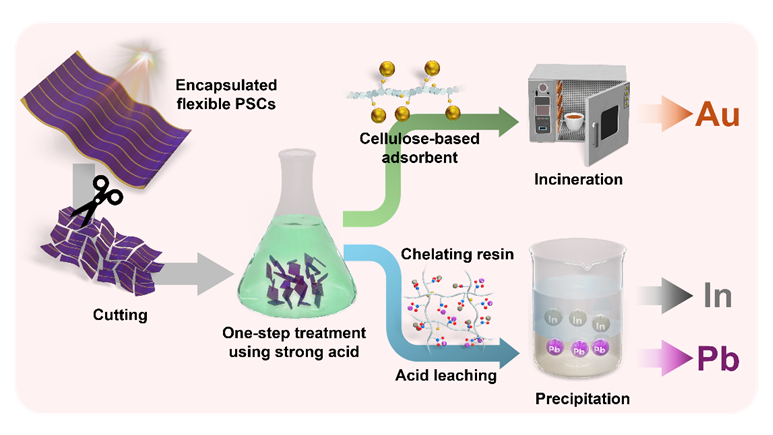
Figure: Schematic of the decomposition process and selective metal recovery from PSCs using an acid solvent and adsorbents.
© 2026 Yazawa R. et al., Published by the American Chemical Society. Licensed under CC BY-NC-ND 4.0.
Click here to see the press release【Japanese only】
Journal : ACS Sustainable Chemistry & Engineering
Researcher Information : MD. Shahiduzzaman
Tetsuya Taima
Katsuhiro Maeda
Hiroshi Hasegawa
Related Information
School of Chemistry, College of Science and Engineering, Kanazawa University
Graduate School of Natural Science and Technology, Kanazawa University
Nanomaterials Research Institute, Kanazawa University
Nano Life Science Institute, Kanazawa University
 PAGE TOP