




Researchers associate professor Mitsunori Ozaki, professor Satoshi Yagitani, and associate professor Shoya Matsuda of the Faculty of Electrical, Information and Communication Engineering, Institute of Science and Engineering / Advanced Research Center for Space Science and Technology, Kanazawa University, together with professor Yoshiya Kasahara of the Emerging Media Initiative / Advanced Research Center for Space Science and Technology, Kanazawa University, and an international collaborative research group including professor Keisuke Hosokawa of the Department of Information and Network Engineering, Graduate School of Information Science and Engineering / Research Center for Space and Electromagnetic Environment, University of Electra-Communications, have succeeded in observing a previously unreported phenomenon: a “ring‑shaped rapidly expanding pulsating aurora” (*2). This discovery was made through coordinated observations using an all‑sky auroral imaging system installed in Sodankylä, Finland, and the Exploration of energization and Radiation in Geospace "Arase" (ERG) (*1), which observes the Earth’s magnetosphere.
By integrating observations from both space and ground, the team revealed that this giant ring‑shaped aurora is created by the rapid expansion of the source region of “chorus waves” (*3), a natural plasma wave occurring in outer space. Furthermore, high‑time‑resolution optical observations from the ground showed that the timing delay between the auroral expansion and the detection of chorus waves coincides.
This phenomenon may serve as a “screen” that visualizes the spatiotemporal variations of chorus wave sources in outer space. The findings suggest that observing pulsating auroras from the ground could enable imaging of plasma variations in geospace.
Researchers at Kanazawa University contributed particularly to the observation and analysis of chorus waves.
This research was published online in the academic journal "AGU Advances" on June 4, 2026.
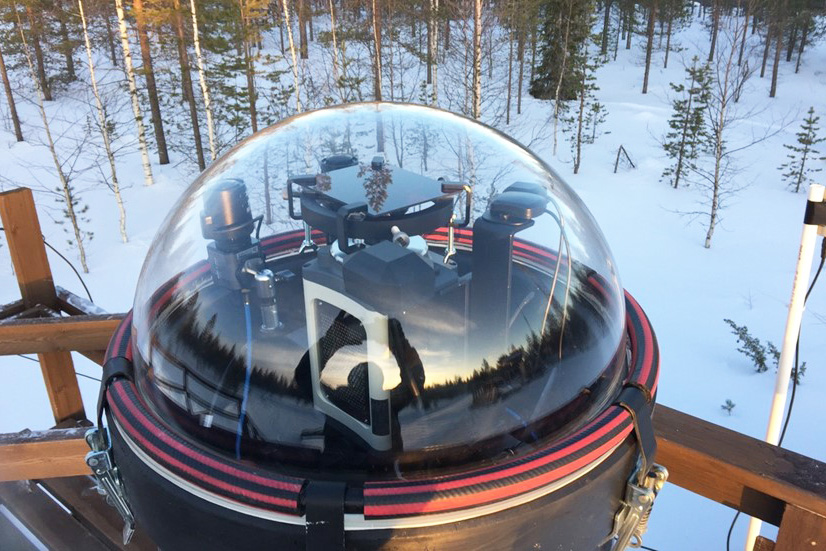
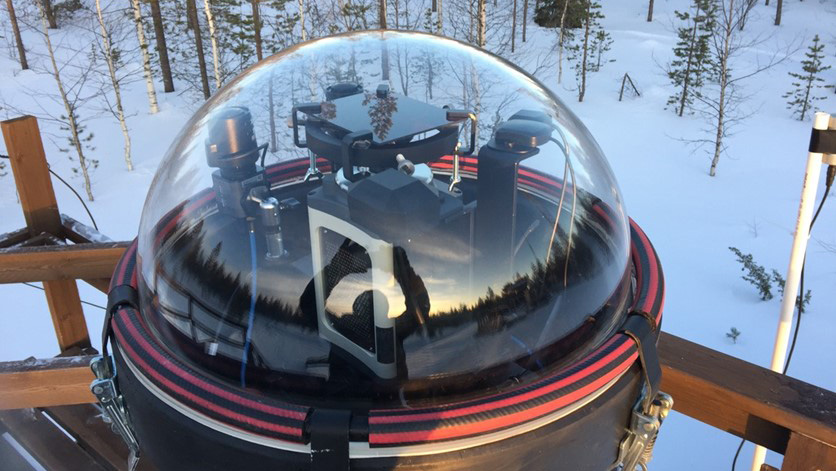
Figure 1: An EMCCD all‑sky camera operated in Sodankylä, Finland (center). It can capture 100 auroral images per second. (Photo: The University of Electro-Communications)
*1 Exploration of energization and Radiation in Geospace "Arase" (ERG)
A Japanese geospace exploration satellite aimed at elucidating the generation and loss processes of high‑energy electrons in the Earth’s radiation belts (Van Allen belts).
*2 Pulsating Aurora
Aurora that appears during the recovery phase of auroral substorms in polar regions, repeatedly brightening and dimming in patchy forms with periods of several to several tens of seconds.
*3 Chorus Waves
Natural electromagnetic plasma waves generated near the Earth’s magnetic equatorial plane in outer space. They play a role in scattering and precipitating high‑energy electrons.
Click here to see the press release【Japanese only】
Journal : AGU Advances
Researcher Information : Mitsunori Ozaki
Yoshiya Kasahara
Satoshi Yagitani
Shoya Matsuda
Related Information
School of Electrical, Information and Communication Engineering, College of Science and Engineering, Kanazawa University
Emerging Media Initiative, Kanazawa University
 PAGE TOP