




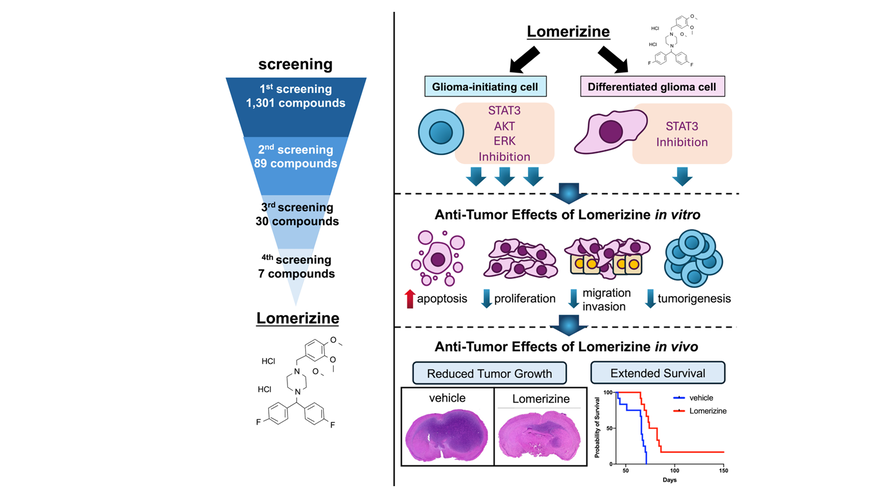
A joint research group at Kanazawa University, led by Professor Mitsutoshi Nakada and Assistant Professor Toshiya Ichinose at the Department of Neurosurgery and Professor Michihiro Mieda at the Department of Integrative Neurophysiology in the Graduate School of Medical Sciences, and Professor Atsushi Hirao at the Division of Molecular Genetics in the Cancer Research Institute, has identified lomerizine as a potential new therapeutic agent targeting glioblastoma stem cells.
Glioblastoma is the most malignant primary brain tumor. A combination therapy of surgery, chemotherapy, and radiation therapy is performed; however, the two-year survival rate remains below 50%, and the mortality rate is nearly 100%. Glioblastoma cells contain special cells called glioblastoma initiating/ stem cells (GICs), which possess the ability to self-renew and differentiate into various cell types and to be involved in recurrence and treatment resistance. Therefore, novel treatments targeting GICs may make it possible to cure glioblastoma.
Professor Nakada's research group identified lomerizine, an existing drug, as a potential therapeutic agent targeting GICs using the drug repurposing approach. T-type calcium channel blocker lomerizine is a drug commonly used for the prevention of migraines mainly in Japan. These findings suggest that lomerizine is a promising therapeutic candidate targeting GICs, with the potential to suppress recurrence and progression in glioblastoma patients and improve long-term prognosis. Since no treatments currently exist that specifically target GICs, it is expected that a new therapy using lomerizine will significantly advance the management of glioblastoma. These research findings were published in "JCI Insight" at 9:00 a.m. on March 24, 2026.
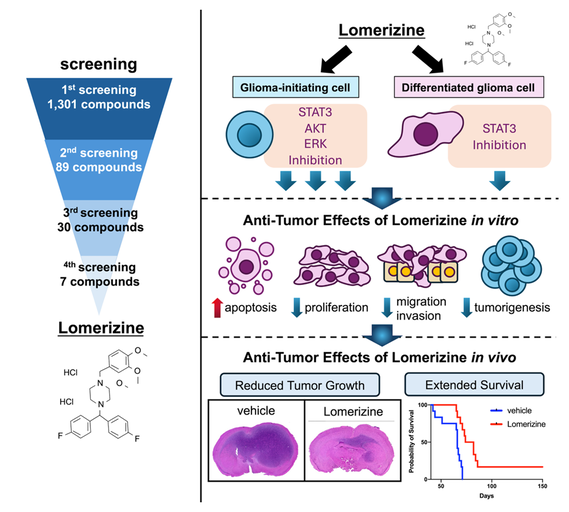
In this study, the researchers screened 1,301 existing compounds for their anti-tumor effects on GICs and identified lomerizine. Experiments using multiple GIC lines and common glioblastoma cell lines revealed that lomerizine induces apoptosis and suppresses their proliferation, especially in GICs. Furthermore, lomerizine was found to inhibit invasion and migration, thereby suppressing glioma progression. An investigation into the mechanism by which lomerizine exerts its anti-tumor effects on glioma cells revealed that it suppresses the activation of STAT3, a key factor in tumor progression, across all glioma cell lines. Additionally, it was demonstrated that lomerizine reduced AKT and ERK phosphorylation, predominantly in GICs. Finally, in intracranial mouse models established by transplanting GICs into the brain, lomerizine treatment suppressed tumor growth and prolonged overall survival.
This research indicates that lomerizine has the potential to become a novel glioblastoma therapeutic targeting GICs. Further preclinical studies and appropriately designed clinical trials will be needed to evaluate the safety and efficacy of lomerizine in patients with glioblastoma. The discoveries made in this study are expected to contribute significantly to the future advancement of glioblastoma treatment.
-
-
-
-
-
-
Click here to see the press release【Japanese only】
Journal : JCI Insight
Researcher Information : Mitsutoshi Nakada
Toshiya Ichinose
Michihiro Mieda
Atsushi Hirao
Related Information
Cancer Research Institute, Kanazawa University
Nano Life Science Institute, Kanazawa University
 PAGE TOP