




【Key Points】
- Launch of interdisciplinary research combining data science (advanced cryptography) and medicine (radiological image diagnosis) to address challenges in clinical practice
- NICT and Ritsumeikan University enhance privacy protection and security functions of federated learning technology using advanced cryptography
- Shinshu University, Shiga University of Medical Science, Kanazawa University, and Mie University conduct clinical research aiming to realize AI-based radiological image diagnosis support
The National Institute of Information and Communications Technology (NICT, President: Hideyuki Tokuda) is using the privacy-preserving federated learning technology “DeepProtect” (*1), developed by the Security Fundamentals Laboratory of the Cybersecurity Research Institute, to enhance and advance AI-based radiological image diagnosis. To achieve this, it is collaborating with Ritsumeikan University (President: Yoshio Nakatani), Shinshu University (President: Soichiro Nakamura), Shiga University of Medical Science (President: Shinji Uemoto), Kanazawa University (President: Takashi Wada), and Mie University (President: Masaaki Ito). They jointly proposed the research project “Advancement of Federated Learning Technologies Utilizing Advanced Cryptography and Their Application to Medical Data” to the K Program “Cryptographic Technologies Supporting Secure Data Circulation (Advanced Cryptography)” of the Japan Science and Technology Agency (JST), and the proposal was accepted.
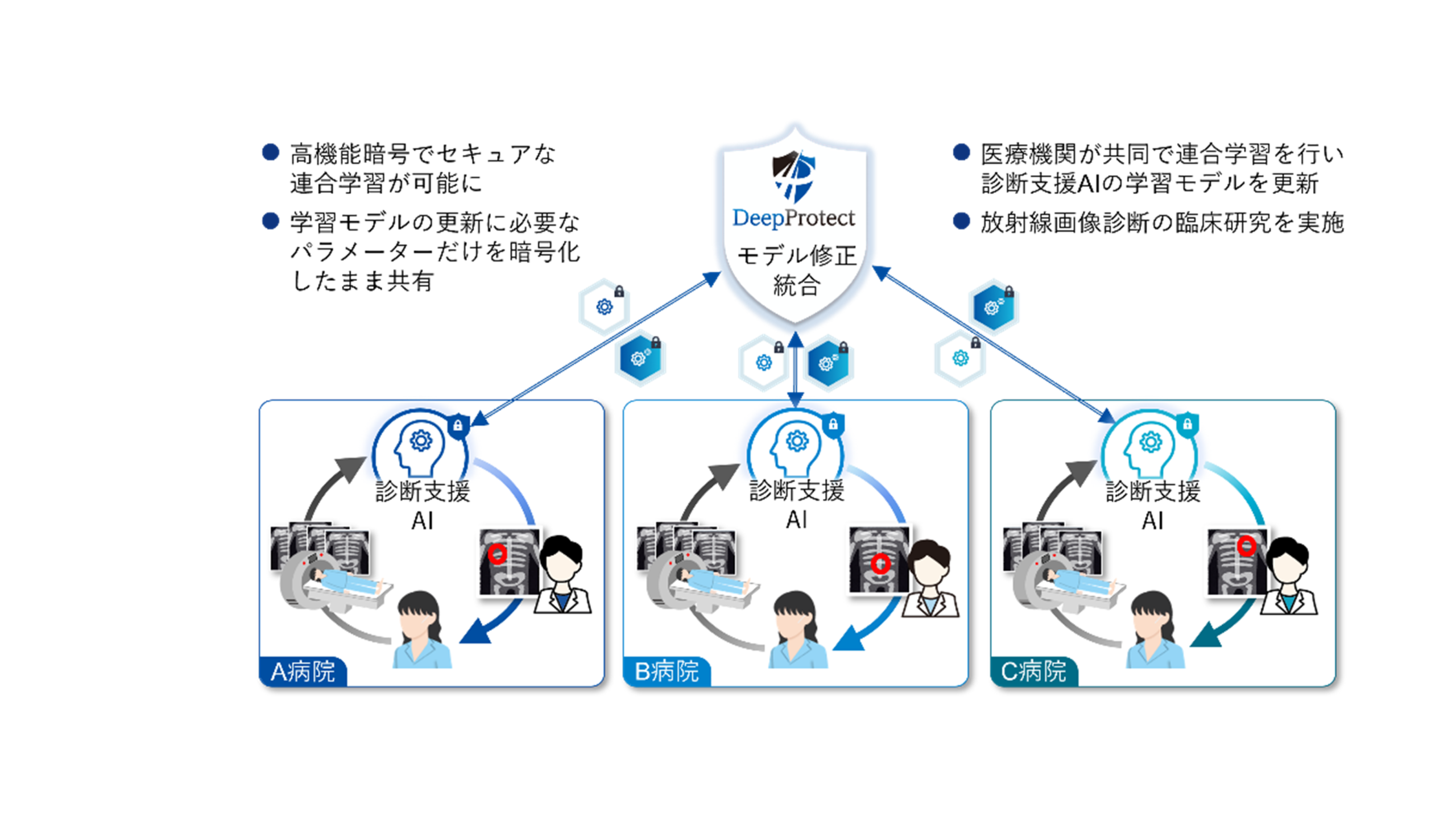
As a result, NICT and Ritsumeikan University—which specialize in advanced cryptographic technologies (*2) and federated learning—will enhance DeepProtect’s personal information protection and security features for medical applications, while Shinshu University, Shiga University of Medical Science, Kanazawa University, and Mie University—which possess a wealth of clinical cases and data—will launch a cross-disciplinary joint research project to use DeepProtect for the research and development of AI-based radiological image diagnosis support (Figure 1).
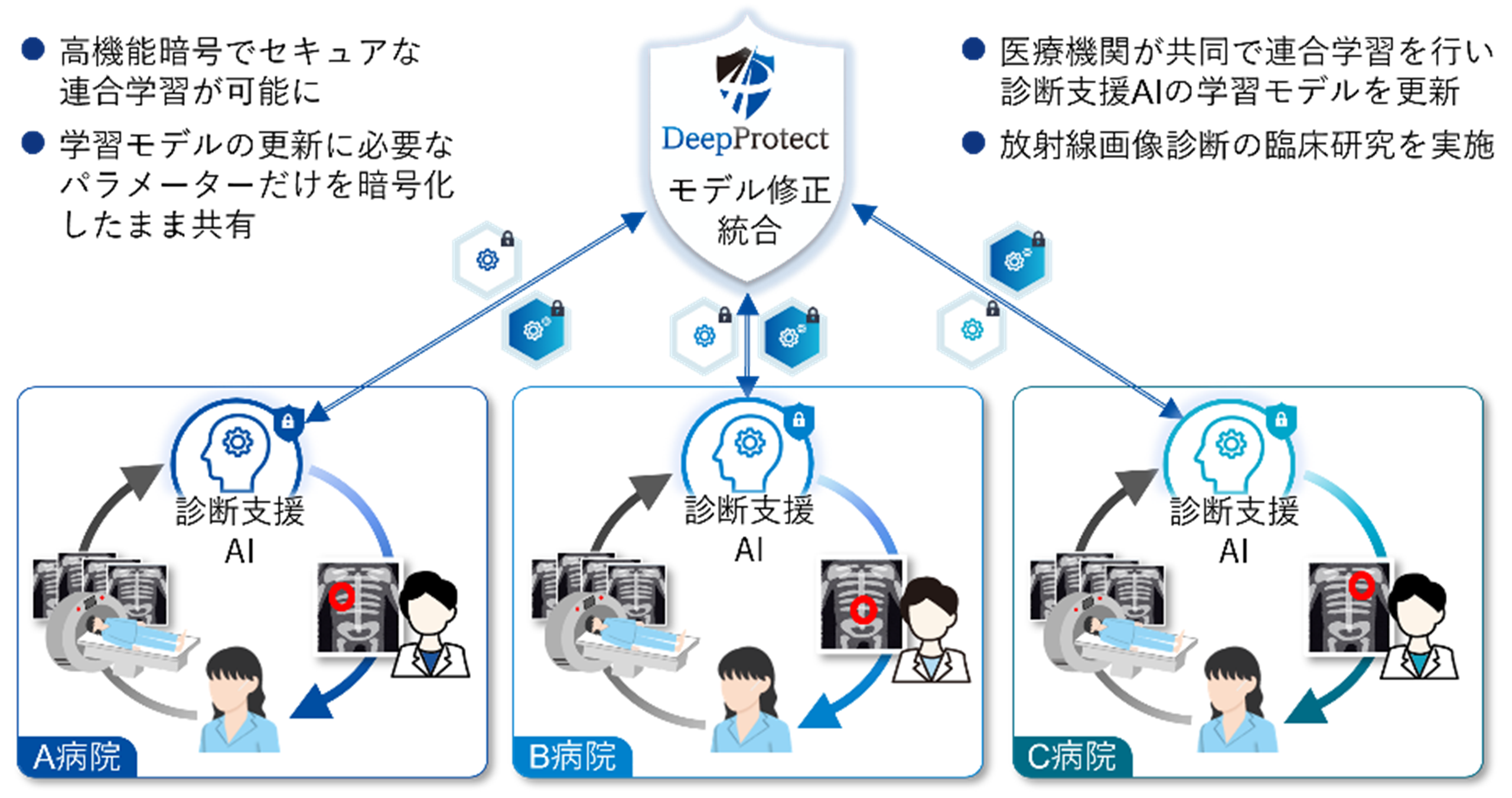
Figure 1: Conceptual illustration of a pilot test for AI-assisted radiological image diagnosis
*1 “DeepProtect,” a privacy-preserving federated learning technology
This is a privacy-preserving federated learning technology independently developed by NICT by integrating cryptographic techniques with federated learning technology. First, when performing deep learning based on data held by each organization, the gradient information (training updates) being trained is encrypted and sent to a central server, where the model parameters (weights) of the learning model are updated while remaining encrypted. Next, by downloading these updated model parameters, each organization can perform more accurate analyses.
DeepProtect encrypts and transmits only the parameters being trained—without sending the actual data from each organization to the central server. These parameters can be rendered non-identifiable by aggregating them into statistical information derived from multiple datasets; furthermore, because they are encrypted, this prevents data leakage to external parties.
This technology enables deep learning based on large volumes of data through collaboration among multiple organizations without disclosing highly confidential data, such as personal data, to external parties.
This technology has been accepted and published in the following journals:
L. T. Phong, Y. Aono, T. Hayashi, L. Wang, and S. Moriai, “Privacy-Preserving Deep Learning via Additively Homomorphic Encryption,” IEEE Transactions on Information Forensics and Security, Vol. 13, No. 5, pp. 1333–1345, 2018.
L. T. Phong and T. T. Phuong, “Privacy-Preserving Deep Learning via Weight Transmission,” IEEE Transactions on Information Forensics and Security, Vol. 14, No. 11, pp. 3003–3015, 2019.
*2 Advanced Cryptographic Technology
This refers to cryptographic technologies that claim to offer advantages over conventional cryptographic technologies—such as added or enhanced features—or that claim to possess new capabilities, such as the ability to solve problems that were difficult to address with conventional cryptographic technologies. In recent years, research and development of advanced cryptography—which encompasses not only traditional functions such as confidentiality, authentication, and digital signatures but also a variety of other functions—has been progressing, and related proposals are being presented at academic conferences and other venues. Advanced cryptography is a field in which Japan holds a competitive advantage; research and development in this area is thriving in Japan, and Japanese-developed advanced cryptography is being presented at many prominent international conferences. Furthermore, standardization efforts for certain advanced cryptographic technologies are underway within organizations such as ISO/IEC.
Click here to see the press release【Japanese only】
Researcher Information : Satoshi Kobayashi
Related Information
 PAGE TOP