




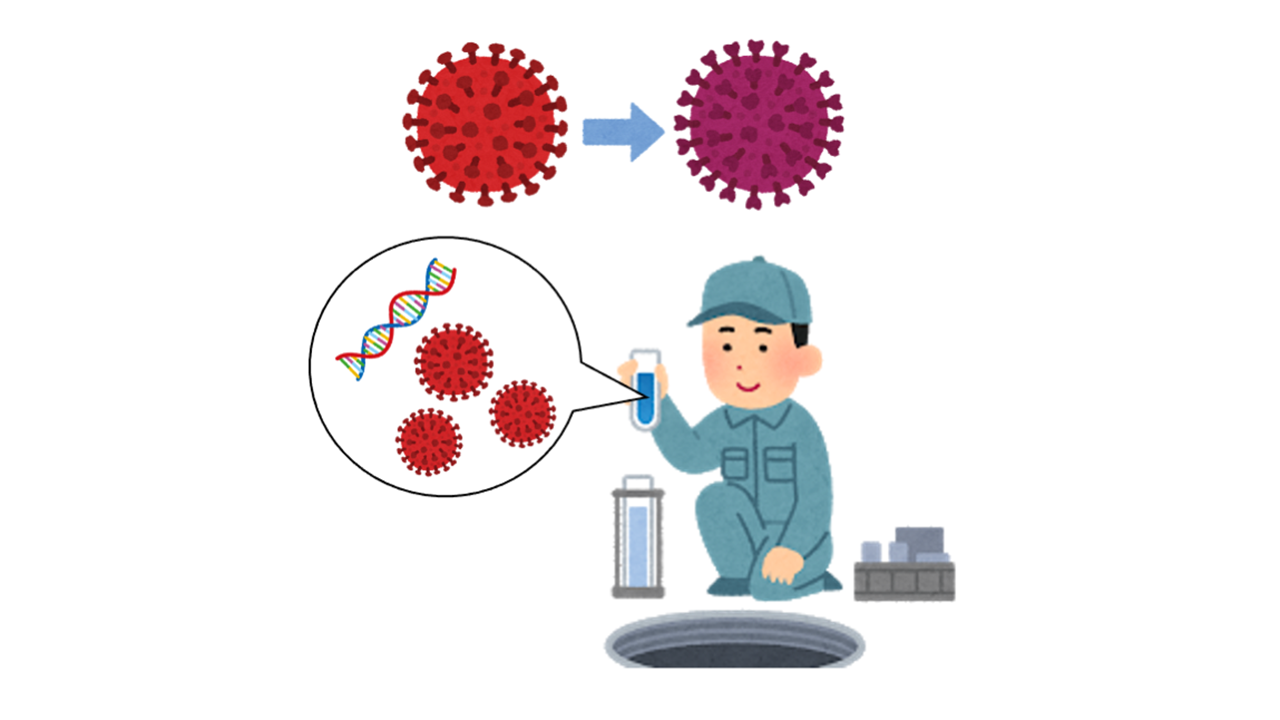
A joint research group consisting of Professor Ryo Honda, Faculty of Geosciences and Civil Engineering, Institute of Science and Engineering, Kanazawa University, Professor Takashi Abe, Department of Electrical and Information Engineering, Graduate School of Natural Science and Technology, Niigata University, Professor Masanori Arita, Research Organization of Information and Systems, National Institute of Genetics, Associate Professor Tomoya Baba, Joint Support-Center for Data Science Research, AdvanSentinel Co., Ltd., Veolia Jenets Co., Ltd., and Kubota Corporation, has succeeded in revealing the emergence and evolution of region-specific mutant sub-variants (*2) of the new coronavirus in a Wastewater-based genomic epidemiology (*1) survey.
In this study, we analyzed in detail the genetic information of novel coronaviruses in sewage from Komatsu City, Ishikawa Prefecture, and Hamamatsu City, Shizuoka Prefecture, and identified significant genomic mutation patterns (stop codons, frameshifts, etc.) caused by region-specific mutant strains and their sub-strains that have not been reported in clinical samples. In particular, we succeeded in detecting the "XBT" mutant strain, which had not been reported clinically in Japan, and demonstrated the possibility of early detection of signs of infection spread by a new mutant strain from sewage.
Wastewater-based genomic epidemiology has revealed differences in the timing of influx and establishment periods of mutant strains and signs of region-specific viral evolution at a high resolution at the sub-lineage level. These findings are expected to contribute to the early detection of infectious diseases and the acceleration of public health measures in the future.
The results are expected to contribute to the early detection of infectious diseases and speed up public health measures in the future.
The results of this research were published in the online edition of the American scientific journal "PLOS One" on May 28, 2025 at 14:00 (U.S. Eastern Standard Time).
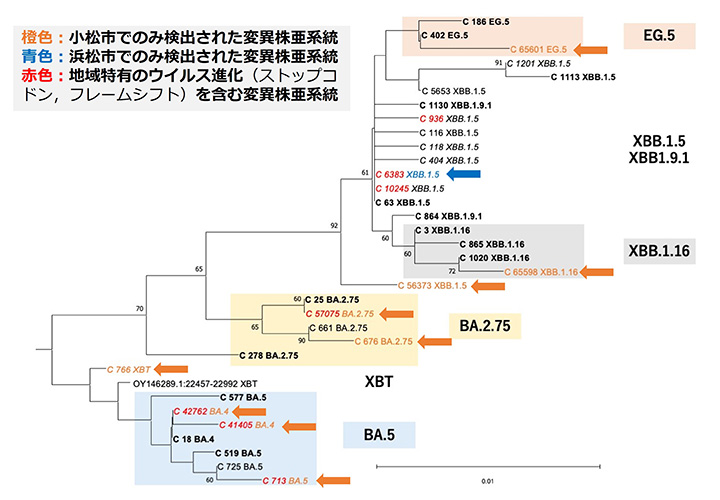
Figure: Evolutionary phylogenetic tree of new coronavirus mutant strain sublineages detected in sewage from Komatsu City and Hamamatsu City
【Glossary】
*1 Wastewater-based genomic epidemiology
The objective is to analyze the genomic (genetic) information of microorganisms and viruses contained in sewage to clarify the prevalence of infectious diseases and the emergence and spread dynamics of mutant strains.
*2 Sub-variant
A variant sublineage that is further subdivided within a particular variant lineage. Sub-variants may reflect region-specific variation.
Click here to see the press release【Japanese only】
Journal : PLOS One
Researcher's Information:Ryo Honda
Related Information
School of Geosciences and Civil Engineering, College of Science and Engineering, Kanazawa University : https://www.se.kanazawa-u.ac.jp/geoandcivil
Graduate School of Natural Science and Technology, Kanazawa University : https://www.nst.kanazawa-u.ac.jp/eng/
 PAGE TOP