




A collaborative research team comprising Jaehun Jung, a fourth‑year doctoral student in the Division of Medicine, Graduate School of Medical Sciences, Kanazawa University; Associate Professor Takashi Maejima, Lecturer Yusuke Tsuno, and Professor Michihiro Mieda of the Faculty of Medicine, Institute of Medical, Pharmaceutical and Health Sciences, Kanazawa University; and researchers from Hokkaido University and the University of Tokyo has identified an ion channel that plays a central role in suppressing neuronal activity at night in the brain’s central circadian clock.
The ion channel identified in this study is the GIRK channel (*1). When activated, GIRK channels allow potassium ions to flow out of the cell, thereby suppressing neuronal activity. This study demonstrated that GIRK channels play a central role in generating distinct patterns of neuronal activity during the day and at night in the suprachiasmatic nucleus (SCN), the central circadian clock.
The research group focused on a specific population of neurons in the SCN that release Prokineticin 2 (Prok2) (*2), a signaling molecule. They found that Prok2-producing neurons exhibit a daily rhythm in their activity, with higher activity during the day and lower activity at night. They further identified GIRK channels as the key molecular components responsible for suppressing the activity of these neurons at night.
Furthermore, using genetic engineering techniques to remove GIRK channels from Prok2-producing neurons in mice, the researchers demonstrated that this manipulation not only abolished the daily rhythm of neuronal activity but also disrupted the animals’ daily activity rhythm. In particular, the markedly delayed onset of nighttime activity in these nocturnal mice resembles a symptom of delayed sleep–wake phase disorder, a type of circadian rhythm sleep–wake disorder in humans (*3) commonly characterized by difficulty waking up in the morning.
This study represents a major advance in our understanding of the molecular mechanisms by which the circadian clock generates distinct patterns of activity during the day and at night. The findings may also contribute to the development of new strategies for preventing and treating conditions caused by circadian disruption, including sleep–wake disorders and autonomic dysfunction.
The findings were published online in the U.S. scientific journal "The Journal of Neuroscience" on July 31, 2026.
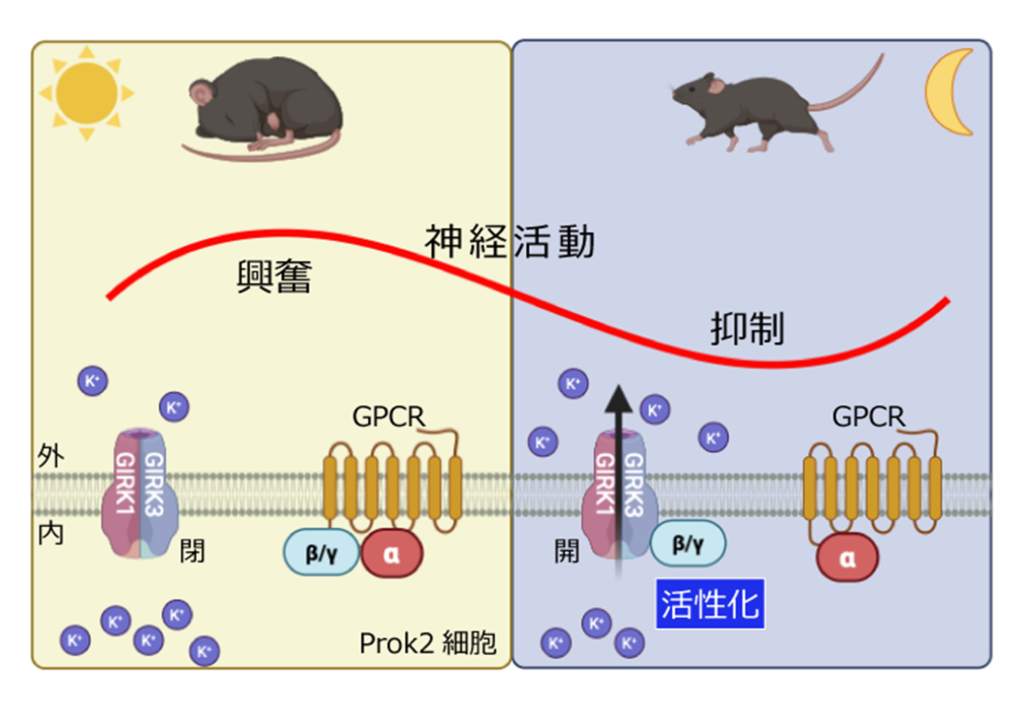
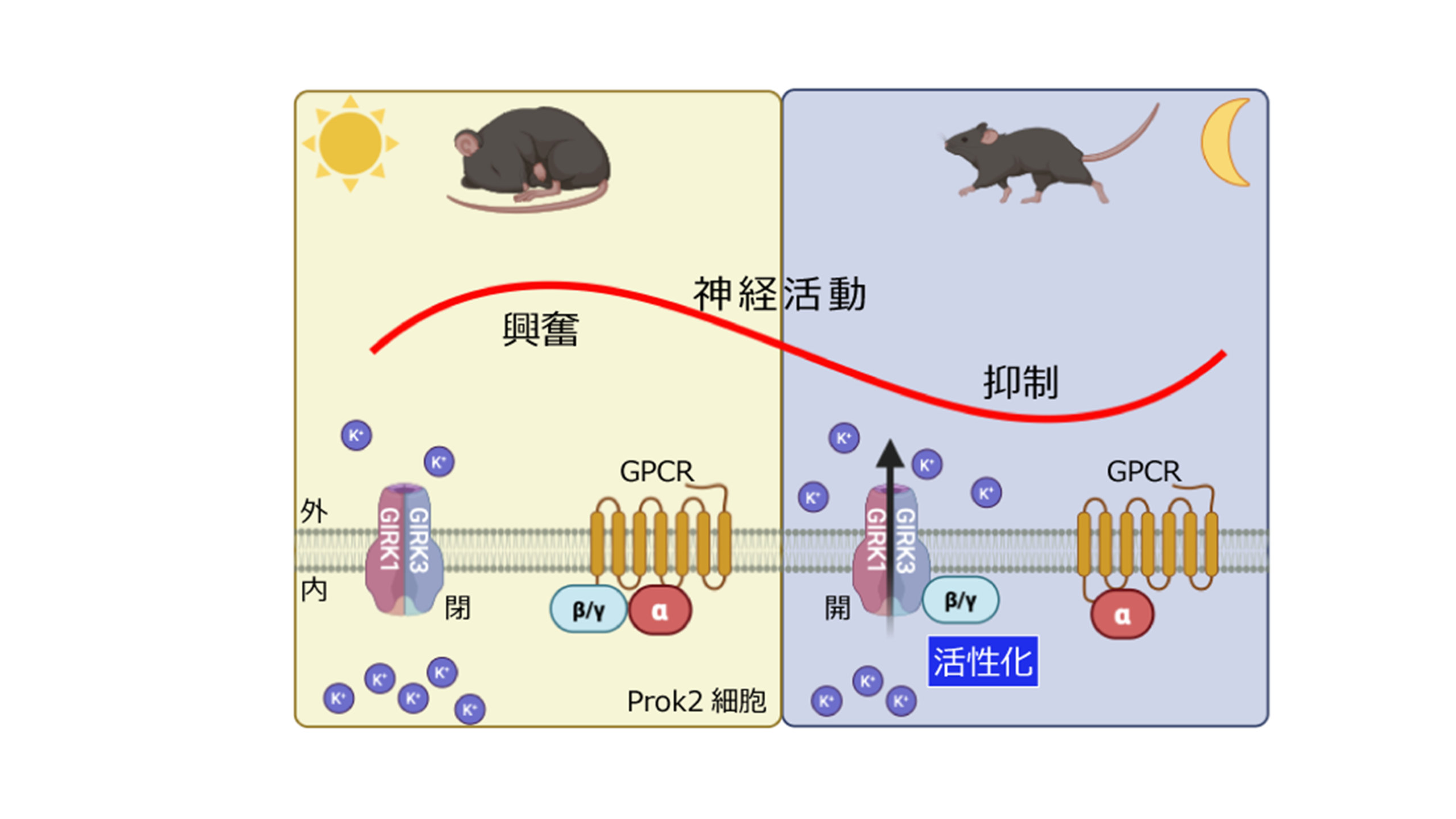
Figure 1. Night-specific activation of GIRK channels generates the day–night difference in electrical activity.
Prok2-producing neurons in the SCN express GIRK channels composed of GIRK1 and GIRK3 subunits. These channels are selectively activated at night, allowing K⁺ ions to flow out of the neurons. The resulting hyperpolarization of the membrane potential reduces neuronal excitability. Although GIRK channels are well known to be activated downstream of G protein-coupled receptors (GPCRs), the mechanism responsible for their selective activation at night remains to be elucidated.
【Glossary】
*1 GIRK Channel
GIRK stands for G protein‑coupled inwardly rectifying potassium (K⁺) channel. GIRK channels are a type of ion channel found in neuronal membranes. When activated by G proteins, they allow K⁺ ions to flow out of the cell, thereby reducing neuronal excitability.
*2 Prokineticin 2 (Prok2)
Prokineticin 2 is a secreted peptide composed of 81 amino acids. Prok2 functions as a signaling molecule that carries information between various types of cells. It is also expressed in the SCN, the central circadian clock, where it mediates communication among neurons within the SCN and conveys time-of-day information generated in the SCN to other brain regions.
*3 Circadian Rhythm Sleep–Wake Disorders
A collective term for sleep–wake disorders caused by dysfunction of the body’s circadian clock, in which the sleep–wake cycle or the timing of sleep and wakefulness becomes misaligned with the schedule required for daily social life. These disorders include jet lag disorder, which causes physical and mental disturbances following air travel across time zones; shift work disorder, which arises from working shifts that conflict with the circadian rhythm; advanced sleep–wake phase disorder, in which a person becomes sleepy unusually early and wakes early in the morning; delayed sleep–wake phase disorder, in which sleep and wake times are substantially delayed; and non-24-hour sleep–wake rhythm disorder (free-running type), in which a cycle longer than 24 hours causes sleep and wake times to shift progressively later each day.
Click here to see the press release【Japanese only】
ジャーナル名:The Journal of Neuroscience
研究者情報:Takashi Maejima
Yusuke Tsuno
Michihiro Mieda
Related Information
 PAGE TOP