




*****The following content was written by the author(s) of the paper.*****
Synthetic materials rarely mimic the dynamic helicity observed in biological systems like DNA and proteins, often forming fixed structures early in assembly. Inspired by this adaptability, researchers at Chiba University, Keele University, Shizuoka University, Kanazawa University, and Ritsumeikan University developed a chlorophyll‐based supramolecular polymer that gradually evolves from nonhelical fibers into helical structures through intermediate stages. This stepwise, cooperative transformation offers a new strategy for designing adaptive materials with tunable optical and electronic properties.
Science has long taken inspiration from the natural world, and few natural designs are as iconic as the helical shape that makes life possible. The best‐known example of such a molecule is DNA, a double helix that carries the genetic instructions for all living organisms. Similar helical shapes are also found in proteins. This shape is special in that it imparts a certain adaptability to biological molecules. For instance, by changing how tightly they twist or even the direction of their twist, biological systems can respond and adapt to their environment. This helps proteins adjust their shapes to fold correctly and perform essential tasks.
Inspired by this design, researchers from Chiba University, Shizuoka University, Keele University, Kanazawa University, and Ritsumeikan University, Japan, have developed a chlorophyll‐based supramolecular polymer that can gradually transform from nonhelical fibers into well‐defined helical structures over time.
The study was led by Professor Shiki Yagai at the Institute for Advanced Academic Research, Chiba University, along with Balaraman Vedhanarayanan and Ryoma Tsuchida from the Graduate School of Engineering, Chiba University; Shinnosuke Kawai from Shizuoka University; and Martin J. Hollamby at Keele University, UK.
The study was published online in the " Journal of the American Chemical Society" on April 20, 2026.
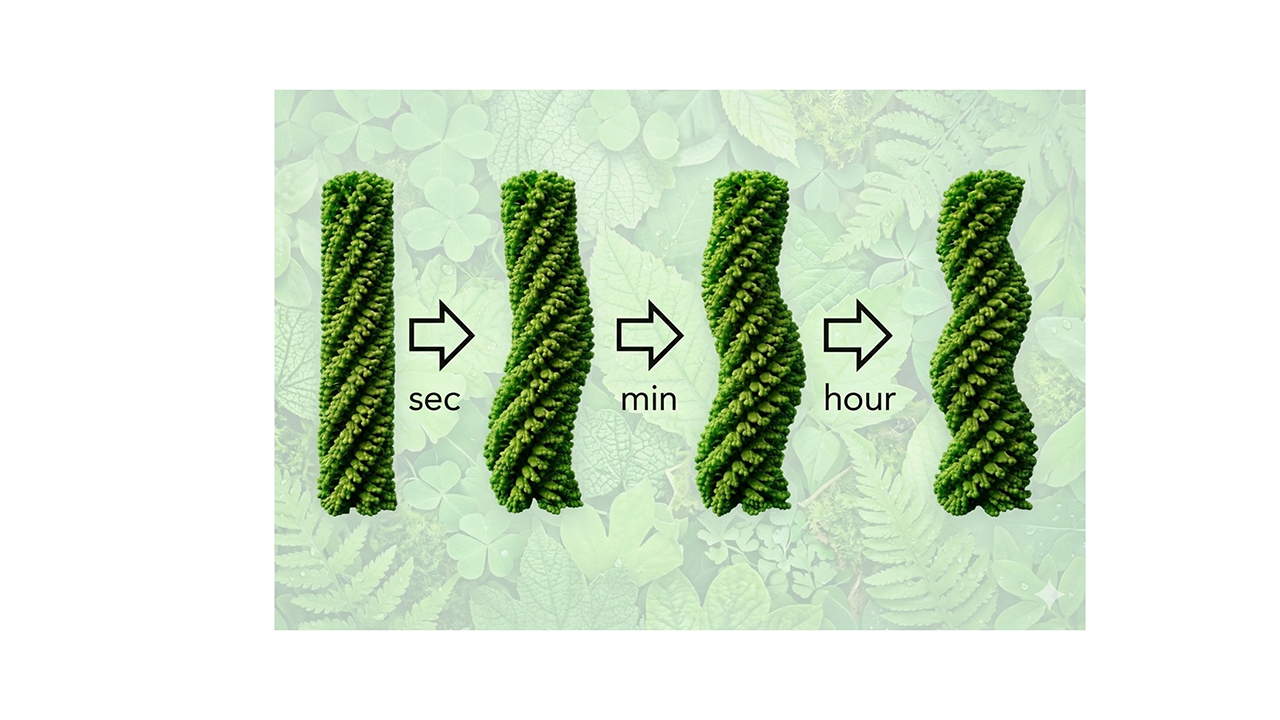
Figure: Time‐Evolving Helicity in Chlorophyll‐Based Polymers
The figure shows how the material evolves from nonhelical fibers into progressively tighter helices over several days. This stepwise transformation demonstrates dynamic helicity in synthetic systems, where structure develops gradually rather than forming instantly.
🄫Professor Shiki Yagai from Chiba University, Japan
Click here to see the press release【Japanese only】
Journal : Journal of the American Chemical Society
Researcher Information : Yuta Hori
Related Information
College of Transdisciplinary Sciences for Innovation, Kanazawa University
Graduate School of Frontier Science Initiative, Kanazawa University
Graduate School of Natural Science and Technology, Kanazawa University
 PAGE TOP