




*****The following content was written by the author(s) of the paper.*****
Researchers at Kanazawa University have identified a previously unrecognized mechanism by which structural changes in the cerebellum influence social behavior. The study demonstrates that disruption of specialized extracellular structures surrounding cerebellar neurons alters neuronal activity across brain circuits involved in social behavior. The findings provide new insight into the neural mechanisms associated with autism spectrum disorder (ASD).
[Background] Autism spectrum disorder (ASD) is a neurodevelopmental condition characterized primarily by difficulties in social interaction and communication. Recent studies suggest that ASD does not arise from abnormalities in a single brain region alone, but rather involves alterations in the function of distributed neural circuits across the brain. Among the brain regions attracting growing attention is the cerebellum. Traditionally known for its role in motor control, the cerebellum is now recognized as an important regulator of emotion, cognition, and social behavior. However, the molecular and cellular mechanisms by which cerebellar abnormalities influence social behavior in ASD have remained largely unclear.
Summary of the Study
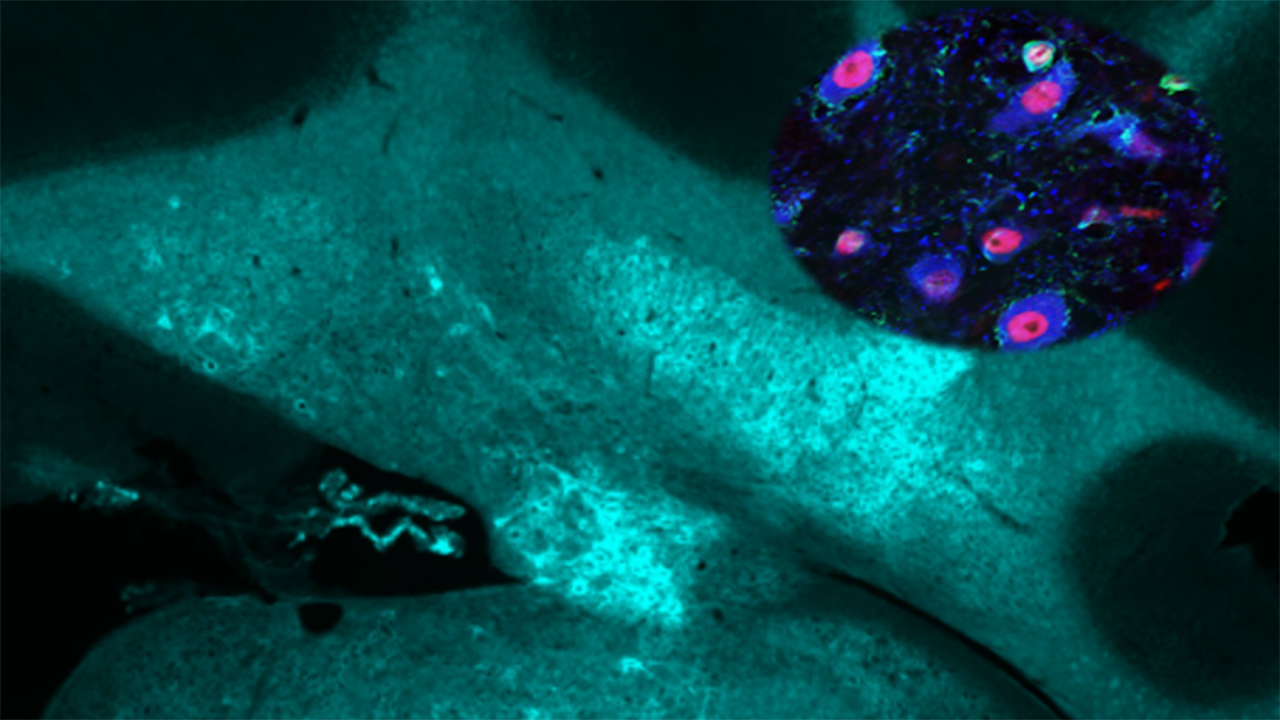
In this study, we investigated where and how ASD-related alterations in social behavior arise in the brain by analyzing multiple mouse models of ASD. Specifically, we examined two widely used models: a prenatal valproic acid (VPA) exposure model, which reflects an environmental risk factor, and a Chd8-deficient mouse model, which reflects a genetic risk factor for ASD. We focused on brain changes shared by both models. We found that in both models, neurons in the deep cerebellar nuclei showed a marked reduction in perineuronal nets (PNNs), specialized extracellular matrix structures that surround neurons. PNNs are thought to play important roles in stabilizing neuronal excitability, regulating information processing, and supporting the maturation of neural circuits.
To test whether this reduction in PNNs is linked to social behavioral changes, we selectively degraded PNNs in the cerebellar nuclei using an enzyme. Mice with disrupted PNNs showed reduced interest in other mice, less social approach behavior, and markedly impaired social interaction. These findings indicate that PNNs in the cerebellar nuclei are essential for normal social behavior.
We further analyzed neuronal activity at multiple levels. In normal mice, social stimulation activated neurons in the cerebellar nuclei, and this activity was transmitted to distant brain regions including the midbrain and thalamus. In contrast, mice with disrupted PNNs failed to show this increase in neuronal activity, and activity across broader cerebellum-linked circuits was reduced. This suggests that local changes in the cerebellum can influence brain-wide neural networks involved in social behavior.
In addition, neurons lacking PNNs showed increased levels of ARNT2, a transcription factor involved in regulating neuronal activity. This increase may make neurons less responsive to stimulation. Importantly, suppressing ARNT2 restored both neuronal activity and social behavior, suggesting that ARNT2 is a key mediator of the effects caused by PNN loss.
Taken together, these results reveal a new mechanism in which reduced PNNs in the deep cerebellar nuclei alter neuronal activity and disrupt broader brain circuits, leading to changes in social behavior.
The results of this research were published in the online edition of Springer Nature, Translational Psychiatry, on May 13, 2026.
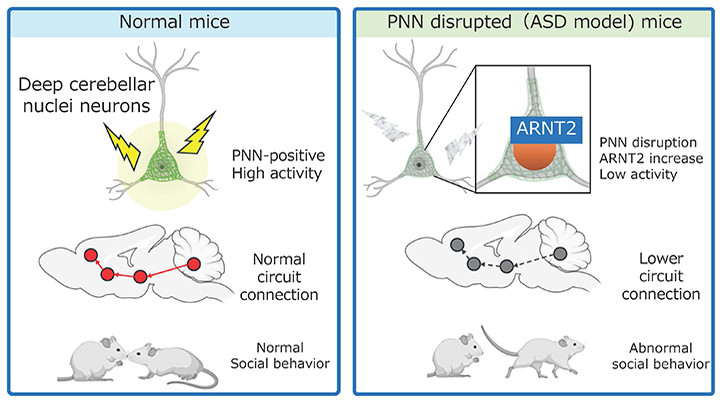
Figure title: Proposed mechanism by which disruption of perineuronal nets (PNNs) in the deep cerebellar nuclei affects social behavior.
In normal mice, neurons in the deep cerebellar nuclei are surrounded by PNNs and show robust neuronal activity during social interaction, allowing normal transmission of signals through cerebellum-linked neural circuits. In ASD-related mouse models and mice with experimentally disrupted PNNs, loss of PNNs is associated with increased ARNT2 expression and reduced neuronal activity. This reduction in cerebellar output is accompanied by decreased activity in downstream brain circuits and impaired social behavior.
[Future Perspectives] Previous ASD research has often focused on the cerebral cortex and synaptic function, while the cerebellum has been discussed mainly in relation to motor symptoms. Our study highlights a previously underappreciated factor—extracellular structures in the cerebellum—as an important regulator of neural circuits involved in social behavior. These findings provide a new framework for understanding ASD not simply as a disorder of a specific brain region, but as a condition involving functional alterations across interconnected neural circuits. By focusing on cerebellar circuitry, this work may also contribute to future efforts to better understand and support social behavioral differences associated with ASD. Further studies will be needed to determine whether similar mechanisms exist in the human brain and whether modulating cerebellar circuit function could contribute to improved understanding and support for social behavior. We expect that this research will serve as an important foundation for advancing the neurobiological understanding of ASD and for considering support strategies that take diverse neurodevelopmental traits into account.
Click here to see the press release【Japanese only】
Journal : Translational Psychiatry
Researcher Information : Kyota Fujita
Shigeru Yokoyama
Related Information
Research Center for Child Mental Development, Kanazawa University
 PAGE TOP