
Yota Tsuge Photo
Research NEWS

Successful Precision Fermentation of Next-Generation Skincare Ingredients from Agricultural By-products

Institute for Frontier Science Initiative, Associate Professor
柘植 陽太TSUGE, Yota

Dr. Hao Wenhui, a postdoctoral researcher at the Institute for Frontier Science Initiative, Kanazawa University (completed the Graduate School of Frontier Science Initiative), Shungo Yamada, a fourth-year student in the School of Biological Science and Technology, College of Science and Engineering, and Associate Professor Yota Tsuge of the Institute for Frontier Science Initiative, in collaboration with the research group of Professor Kiyotaka Hara of the University of Shizuoka, have successfully developed a technology to produce a high-purity vitamin A compound (retinal) from molasses (*2), an agricultural by-product, using microbial precision fermentation technology (*1).

Retinal is a type of retinoid (*3), an active cosmetic ingredient that has been attracting attention in the skincare field in recent years. Currently, retinol, another retinoid compound, is widely used for anti-aging applications such as wrinkle improvement, firmness enhancement, and collagen production promotion. However, retinal has been reported to exhibit higher efficacy at lower concentrations with antibacterial activity, and interest in this compound has been increasing due to these advantages. Retinoid compounds currently on the market, including retinal, are manufactured through chemical synthesis using petroleum-derived raw materials, which presents challenges from a sustainability perspective.

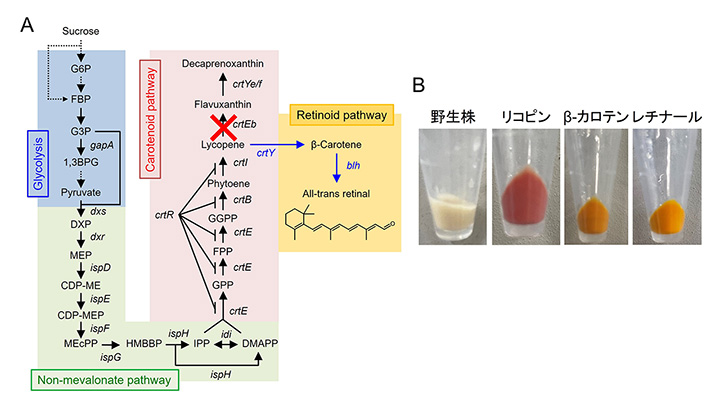
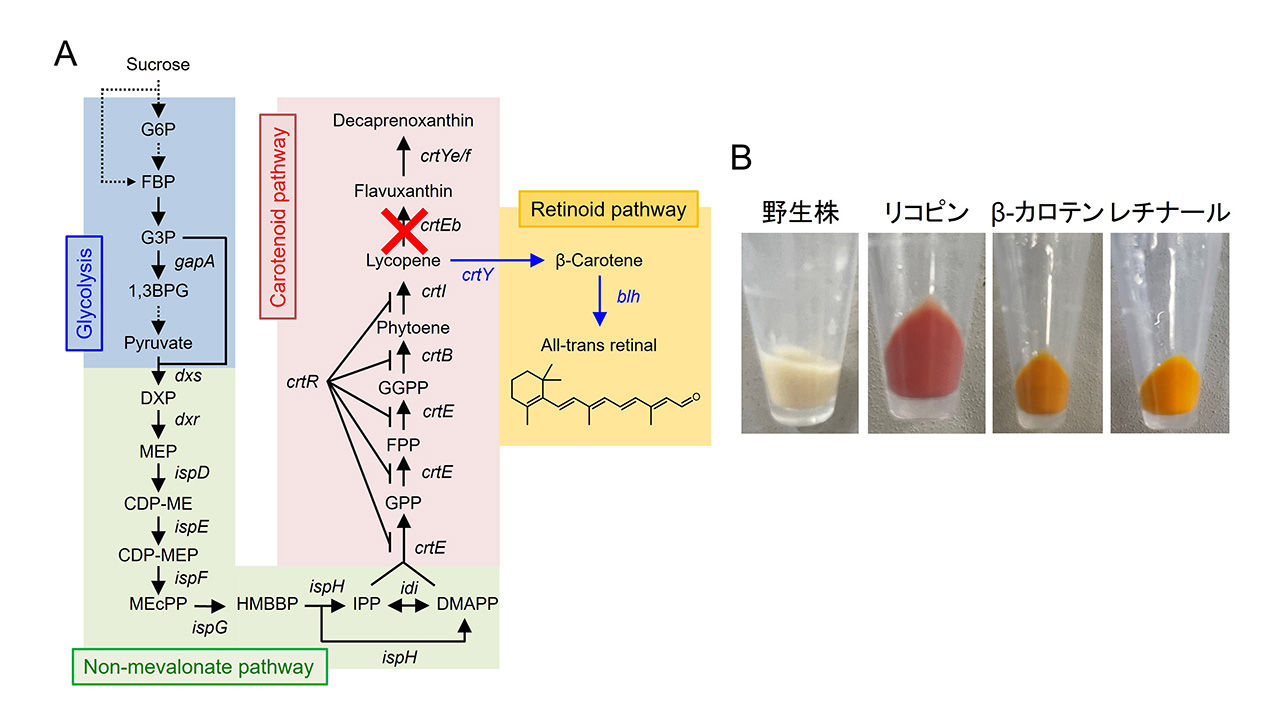
In this study, a retinal-producing strain was created by genetically engineering of coryneform bacteria (*4), which are used as industrial producers of amino acids. Furthermore, by introducing a two-phase cultivation method (*5) using organic solvents, the researchers achieved fermentative production of highly pure retinal without producing other retinoids such as retinol and retinoic acid. Finally, using a molasses-based medium, a retinal production titer of 104.9 mg/L (2,099 mg/L in the organic phase) was achieved in a 2.5 L fermenter.

These findings are expected to serve as a foundation for future fermentation-based production of environmentally friendly next-generation skincare ingredients utilizing renewable resources.

The results of this research were published in the online edition of the international journal "Bioresource Technology" on February 22, 2026.


Figure: (A) Metabolic pathway of retinal synthesis and (B) colors of wild-type, lycopene-, β-carotene-, and retinal-producing strains.


【Glossary】
*1  Precision fermentation technology
A fermentation technology that uses genetic engineering and synthetic biology to design and modify the metabolic pathways of microorganisms to selectively produce specific target substances. While conventional fermentation “utilizes the natural functions of microorganisms,” precision fermentation is characterized by its design aimed at producing specific molecules.

*2  Molasses
An agricultural by-product generated during the sugar refining process from sugarcane or sugar beets. It contains highly concentrated sugar solutions and vitamins and can be used as a component of microbial culture media.

*3  Retinoids
A generic term for vitamin A compounds, including retinal (this study), retinol (vitamin A), and retinoic acid.

*4  Coryneform bacteria
Representative industrially used bacteria discovered in Japan. They are highly safe microorganisms used in the industrial production of amino acids such as glutamic acid and lysine.

*5  Two-phase cultivation method
A microbial cultivation method that simultaneously uses two immiscible liquid phases: an aqueous phase (culture medium) and an organic phase. Microorganisms grow in the aqueous phase, and fat-soluble compounds such as retinal migrate from inside the cells into the organic phase, enabling extracellular extraction at the reaction site.


Click here to see the press release【Japanese only】

Journal : Bioresource Technology

Researcher Information : Yota Tsuge

Related Information

 Institute for Frontier Science Initiative, Kanazawa University : https://infiniti.adm.kanazawa-u.ac.jp/

 School of Biological Science and Technology, College of Science and Engineering, Kanazawa University : https: //www.se.kanazawa-u.ac.jp/lifescience

FacebookPAGE TOP