




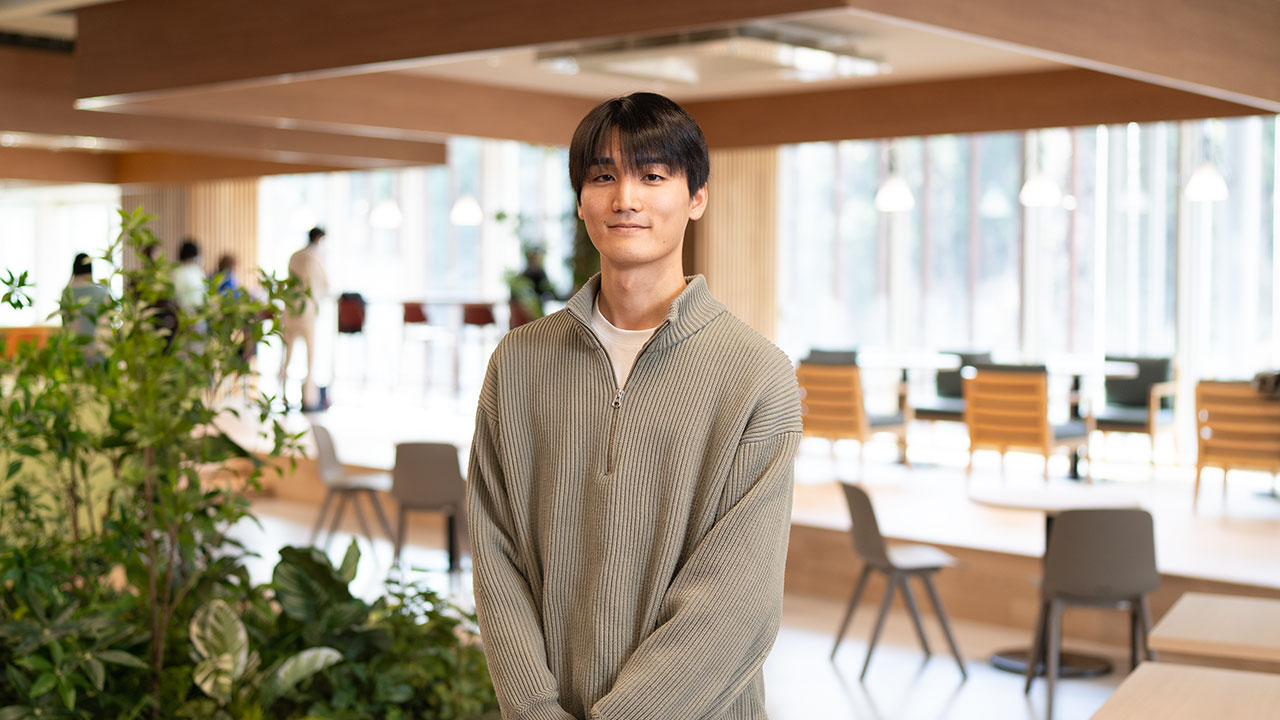
We interviewed Takeru Ishizaki, a third-year doctoral student (at the time of the interview) in Division of Natural Systems, Graduate School of Natural Science and Technology. As a HaKaSe+selected student, he is actively earning the doctor's degree. We interviewed him about the apeeal of the doctoral program and the rewards of research. For video of the interview, please click Official research instagram
What motivated you to pursue a doctoral course?
I was the type to be passionate about something from a young age. For example, in mathematics, I liked to keep thinking on my own without looking at model answers to difficult problems. Because of this personality, I was interested in the world of research, where there were no answers in advance. I went on to the doctoral course when my supervisor, Associate Professor Kosuke Kuroda, asked me if I would like to go to the doctoral course, and I was told about the Nano Precision Medicine and Science and Engineering WISE Program (HaKaSe + for WISE). Knowing that the environment was in place where I could concentrate on my research without financial anxiety, I decided to go on to higher education without hesitation.
Could you tell us about your study?
Our research focuses on a substance called "zwitterion." The zwitterion we have reported are artificially synthesized molecules, yet they have the characteristic of being gentle to living organisms. Taking advantage of their safe properties, we use them as additives for cryopreservation of cells and as solvents for dissolving drugs. The most attractive point is that the molecular structure can be freely designed to suit the purpose while maintaining low toxicity, and it is expected to be applied to a wide range of life science fields, such as cryopreservation of sperm and eggs.
I got involved in this research on the main theme of "cryopreservation of cells" because I was attracted by my supervisor 's words, "It is the most difficult and challenging theme to understand, and that is why it is worthwhile". I felt it was the only way.
What skills or experiences have you gained through HaKaSe+?
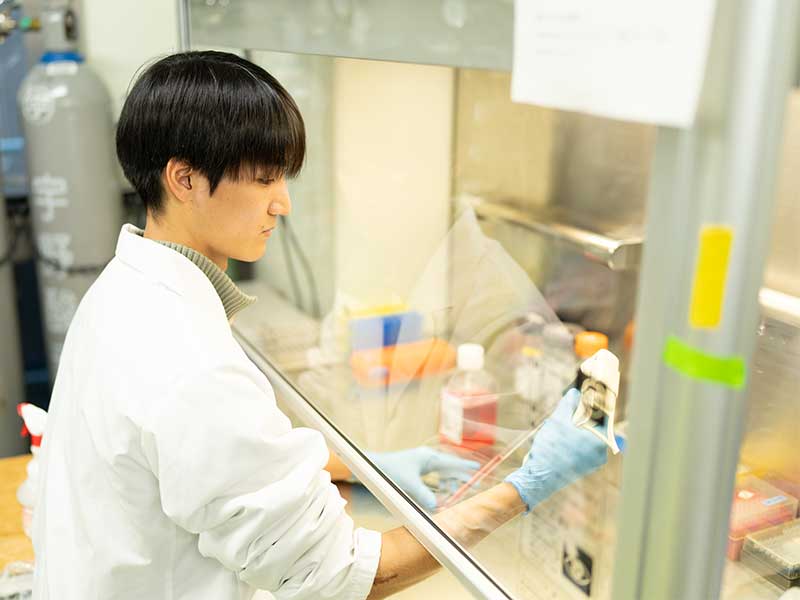
During my first lab rotation, I had the opportunity to work on research in another lab. My research is a mixture of chemistry and biology, but there were many things about biology that I did not understand, so it was a great experience for me to see various experiments with my own eyes in a biology-related lab. It was also a great learning experience to be exposed to uncharted territory by listening to the stories of people who started their own businesses while still in school.
What support or programs have you found helpful at HaKaSe+?
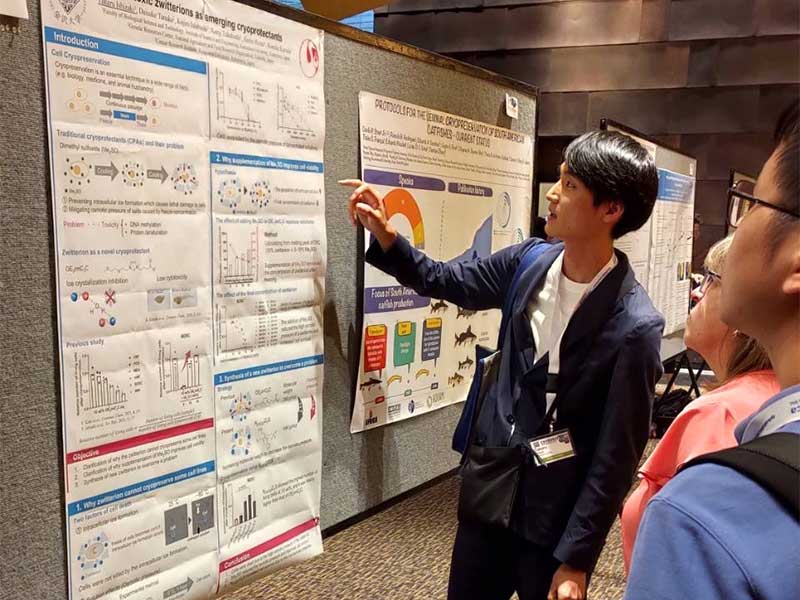
In addition to living support, the research and travel subsidies I received were very helpful. Thanks to this support, I was able to attend international conferences in Lyon, France and Minnesota, USA. It was very stimulating to learn what kind of research is trending now, especially through the research presentations of various people. I also had to speak English with people from overseas, which helped me improve my language skills. It was an experience that even my poor English could be understood if I tried my best, and it gave me a little confidence.
How do you unwind outside of your research?
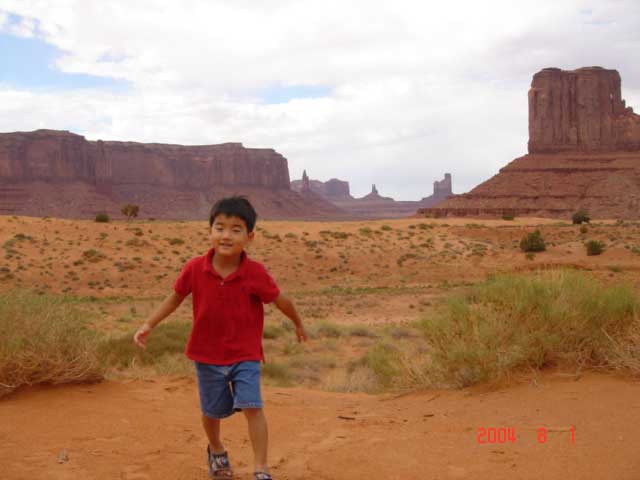
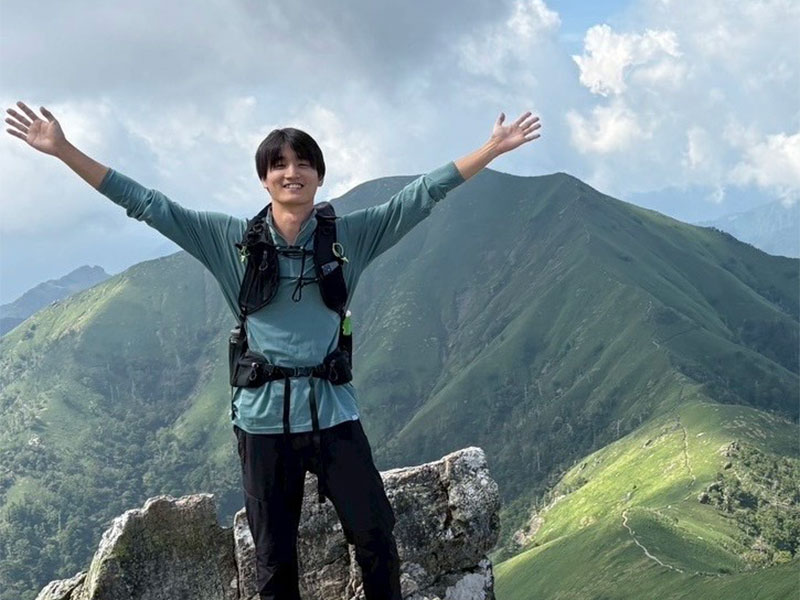
I have always enjoyed outdoor activities and became more fond of nature through my activities in the orienteering club at university. Recently, I also do mountain climbing and trail running, and I challenged the Kanazawa Marathon. My time was not good at all, but I managed to finish the marathon. It is important to refresh my mind and body, so I actively enjoy nature in my private time.
Finally, could you share your dreams for the future?
After completing the program, I plan to continue my research as a researcher in a company. However, I do not have a specific dream for myself. That is because I am doing it intentionally, and I want to challenge "interdisciplinary fusion," which is to open up new areas of research while being involved in other fields. So, for now, I would like to work on anything without specifying a field.
In research, I believe that it is not good to lack either of two things: "how much you can logically prove" or "how much you can have an impact on society. My ideal is to be a researcher who can achieve both of these. I would like to continue to be a researcher who constantly faces "new and difficult issues" that stimulate my curiosity and continues to think persistently.
*Note: All affiliations, academic years, and other information are accurate as of the time of the interview.
(Tamayo Kido, writer)
 PAGE TOP