




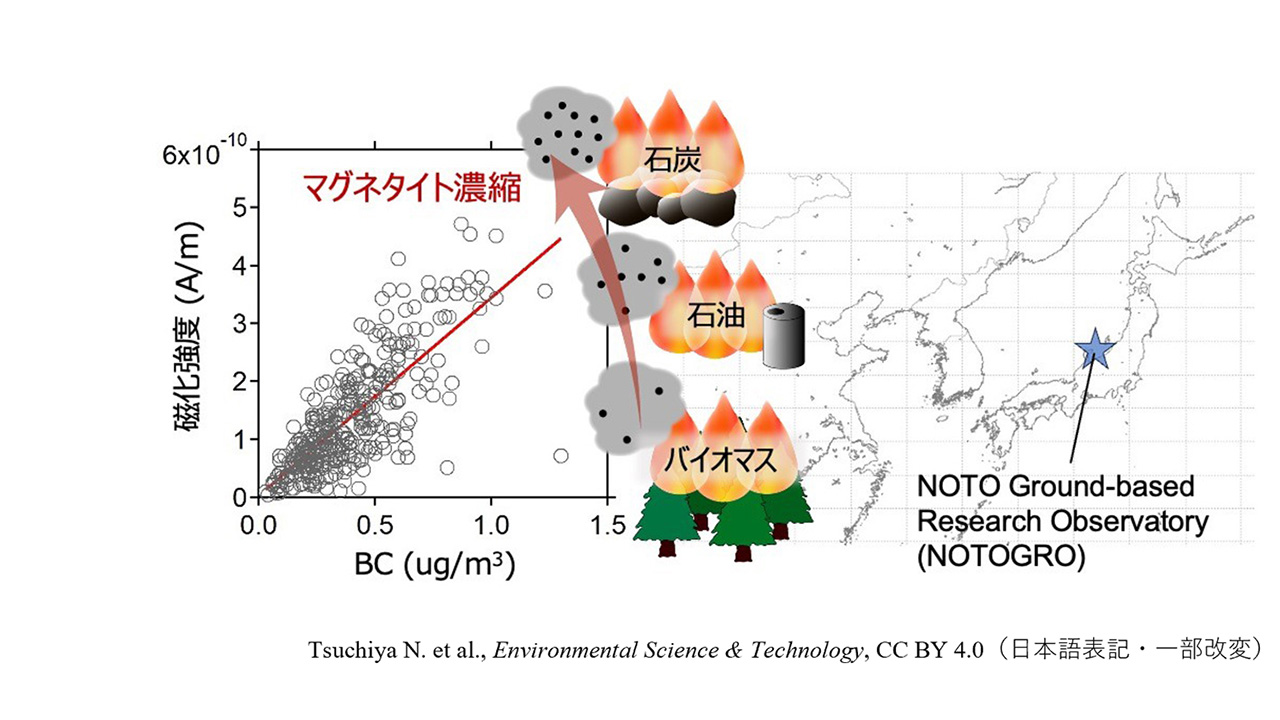
A collaborative research team lead by Professor Atsushi Matsuki of the Institute of Nature and Environmental Technology Kanazawa University, Assistant Professor Nozomu Tsuchiya of the Graduate School of Energy Science, Kyoto University, and Associate Professor Kazuo Kawasaki of the School of Sustainable Design, University of Toyama, has established a novel method for identifying air pollution sources. By combining measurements of aerosol magnetism and observations of black carbon (BC) (*1), the team has uncovered the behavior of combustion-derived magnetite particles in the atmosphere.
Iron oxides contained in fine particulate matter (PM2.5) (*2), particularly magnetite (*3), are known to originate from combustion processes. These particles have been linked to increased health risks due to oxidative stress in the human body, as well as to climate impacts through solar absorption and potential fertilization effects on marine plankton. However, due to limitations in conventional measurement techniques, little has been known about their sources or seasonal variations.
In this study, the researchers focused on the magnetic properties of magnetite. Using a superconducting magnetometer, they non-destructively measured the remanent magnetization (*4) of real atmospheric filter samples collected at an observation site on the Noto Peninsula (*5). This approach enabled, for the first time, year-round observations of magnetite with daily time resolution. By comparing these measurements with black carbon data and detailed chemical analyses, the team found that magnetite is strongly associated with coal combustion and tends to increase in winter due to transboundary pollution from the Asian continent. Furthermore, they estimated that combustion-derived magnetite can account for up to 5% of the total light absorption previously attributed to black carbon, indicating that its warming effect is non-negligible.
The ratio of magnetite to black carbon was found to vary systematically depending on the combustion source following the order : coal combustion > oil combustion > biomass burning. This finding provides a new analytical tool for improving climate model simulations and identifying air pollution sources.
The study was published online on May 22, 2025, in "Environmental Science & Technology", a journal published by the American Chemical Society.
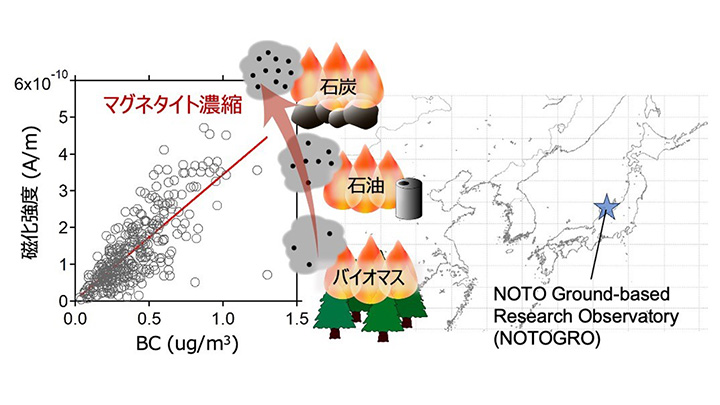
Tsuchiya N. et al.,Environmental Science & Technology, CC BY 4.0 (Japanese notation, partially adapted)
【Glossary】
*1 Black carbon
Also known as soot, black carbon is a component produced by incomplete combustion. It is commonly found in black smoke emissions and appears as dark particles within PM2.5. Because it strongly absorbs sunlight, it contributes to atmospheric heating. Black carbon is considered an important climate-warming agent alongside greenhouse gases such as CO₂.
*2 PM2.5
PM stands for particulate matter. PM2.5 refers to particles with an aerodynamic diameter of 2.5 micrometers or smaller. These fine particles are often used as an indicator of anthropogenic (human-made) air pollution.
*3 Magnetite
Magnetite is an iron oxide with the chemical formula Fe₃O₄. It can originate from natural sources, such as mineral dust (e.g., Asian dust), as well as from combustion processes. In fossil fuels, pyrite (FeS₂) can oxidize at high temperatures during combustion to form magnetite.
*4 Remanent magnetization
Remanent refers to the magnetization retained in a material after exposure to an external magnetic field. In this study, samples were magnetized using a pulsed magnetizer under a direct magnetic field of 1200 mT, followed by the application of a reverse field of 300 mT. This procedure isolates the remanent magnetization associated with magnetite.
*5 Noto Atmospheric Observation Supersite
The Noto Ground-based Research Observatory (NOTOGRO) is located in Suzu City, Ishikawa Prefecture, Japan (37.45° N, 137.36° E). The observation facility is situated within the Noto campus of Kanazawa University and serves as a monitoring site for atmospheric research.
Click here to see the press release【Japanese only】
Journal : Environmental Science & Technology
Researcher Information : Atsushi Matsuki
Related Information
Institute of Nature and Environmental Technology, Kanazawa University : https://www.ki-net.kanazawa-u.ac.jp/
Graduate School of Natural Science and Technology, Kanazawa University : https://www.nst.kanazawa-u.ac.jp/eng/
 PAGE TOP