




*****The following content was written by the author(s) of the paper.*****
A research group led by Dr. Keiko Ueno, Assistant Professor at the Innovative Clinical Research Center, Kanazawa University, has revealed the status of collaboration between fire-based emergency medical service (EMS) agencies (*1) and community-based long-term care (*2), welfare (*3), and health organizations (*4) in Japan. The study identified six key practical measures essential for building a collaborative model that sustains long-term coordination between medical care and social support needs.
As population aging accelerates in Japan, the health and social issues experienced by community residents are becoming increasingly complex. Prehospital emergency care is now expected to go beyond conventional lifesaving and patient transport functions, playing a critical role in bridging medical care and community support—particularly in areas such as social isolation and difficulties accessing care services. To examine the status of collaboration between EMS agencies and local care systems, the research team conducted semi-structured interviews (*5) with 26 paramedics from 20 fire departments nationwide. The findings demonstrate that such collaboration contributes to more efficient response operations, enhanced mutual understanding across professions, and more appropriate ambulance use. At the same time, ambiguities in coordination structures, limited staffing capacity, and barriers to information sharing emerged as major challenges. Furthermore, the study identified six practical strategies that can support sustainable inter-organizational collaboration.
This research is expected to contribute to the development of a new support model that integrates prehospital emergency care with community-based integrated care systems.
The results were published online in the international journal "Prehospital Emergency Care" on December 8, 2025.
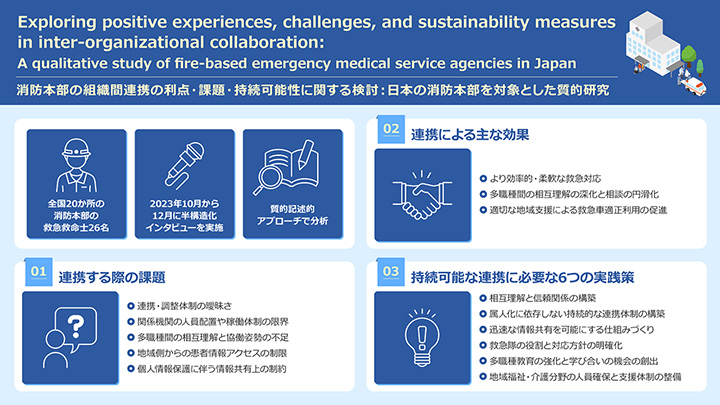
Figure 1 : Overview of the study
【Glossary】
*1 Fire-based emergency medical service agencies
Core municipal organizations responsible for firefighting and EMS operations, supervising fire stations and EMS teams.
*2 Long-term care organizations
Providers of daily living and care services for older adults and individuals with disabilities.
*3 Welfare organizations
Institutions supporting people facing social vulnerabilities (e.g., community welfare councils, child & family support centers).
*4 Health Organizations
Institutions providing community health services and disease prevention (e.g., public health centers).
*5 Semi-structured interview
A qualitative interview method that follows prepared questions while allowing flexible probing based on participants’ responses.
Click here to see the press release【Japanese only】
Journal : Prehospital Emergency Care
Researcher’s Information:Keiko Ueno
Related Information
Innovative Clinical Research Center, Kanazawa University Hospital
 PAGE TOP