




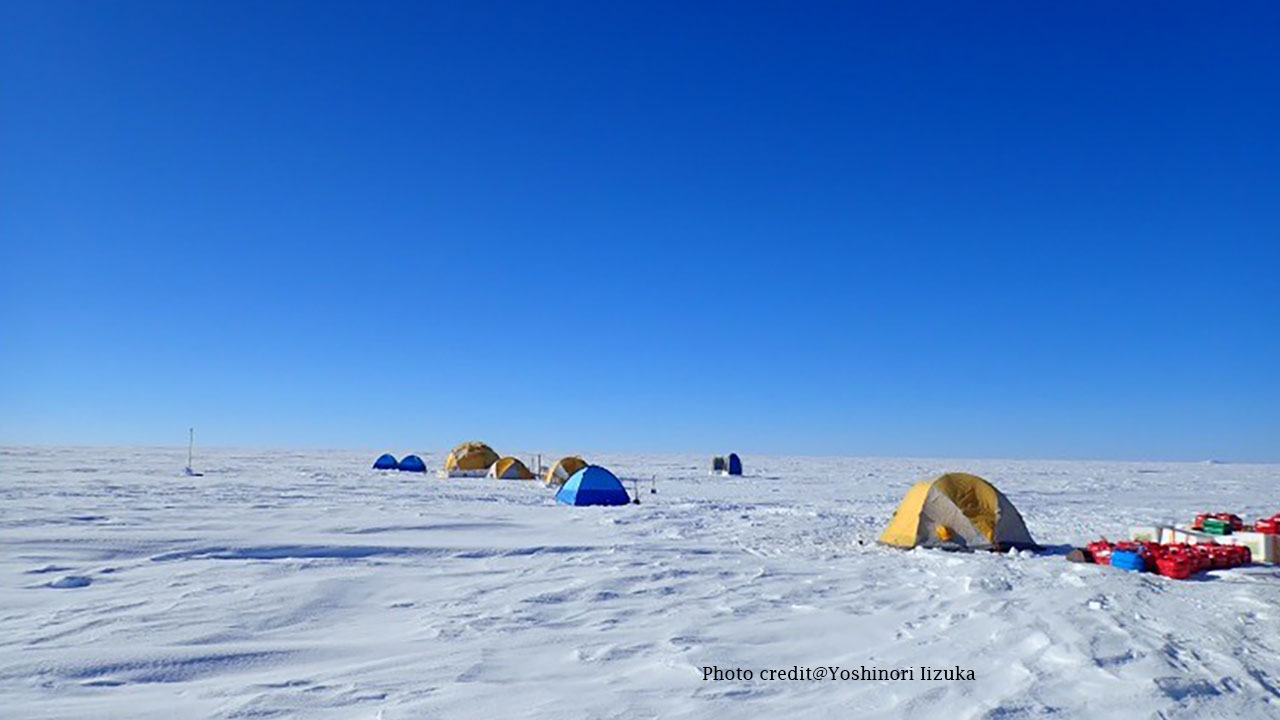
A research team comprising Associate Professor Yoshinori Iizuka and Assistant Professor Sumito Matoba from the Institute of Low Temperature Science at Hokkaido University, Assistant Professor Sakiko Ishino from the Institute of Nature and Environmental Technology at Kanazawa University, Associate Professor Shohei Hattori from Nanjing University in China, and Professor Koji Fujita from the Graduate School of Environmental Studies at Nagoya University has revealed that there is a time lag between changes in atmospheric nitrate (*2) concentrations—recorded in Greenland ice cores (*1) from the Industrial Revolution to the present—and variations in anthropogenic nitrogen oxide (NOx) (*3) emissions. The study further demonstrates that this time lag is caused by changes in the efficiency of long-range transportability of atmospheric nitrate, which depends on atmospheric acidity.
Arctic ice cores provide a continuous record of atmospheric nitrate, a key factor influencing air quality and climate, from the past to the present. Previous analyses of ice cores from central Greenland yielded uncertain data due to significant photolytic loss of nitrate from snow after deposition. The research team identified that ice cores collected from the high snow accumulation, southeastern dome of the Greenland ice sheet are well suited for reconstructing nitrate levels and successfully reconstructed a continuous record of nitrate concentrations from the Industrial Revolution to the present (1800–2020). Overall, nitrate levels in the ice core over the past 220 years generally corresponded to variations in NOx emissions. However, detailed analysis revealed a time lag: the peak in ice-core nitrate concentrations occurred later than the peak in NOx emissions during the 1970s, and high concentrations persisted even after NOx emission controls were introduced in the 1990s. Using a global atmospheric chemistry transport model, the team demonstrated that this time lag resulted from a partial shift in nitrate from a gaseous form, which deposits easily, to a particulate form, which is more readily transported over long distances, driven by the neutralization of atmospheric acidity since the 1970s.These findings are expected to contribute to the development of future air quality mitigation strategies and improve the accuracy of climate change predictions.
The research results were published in Nature Communications on Monday, May 19, 2025 (Japan Standard Time).
【Key points of this research】
・Using Greenland ice cores, the team accurately reconstructed the changes in atmospheric nitric acid levels from the Industrial Revolution to the present.
・The time lag between human nitrogen oxide (NOx) emissions and changes in ice core nitrate was found to be significant.
・The study revealed that this time lag is caused by changes in the long-range transportability of atmospheric nitric acid, which depends on atmospheric acidity
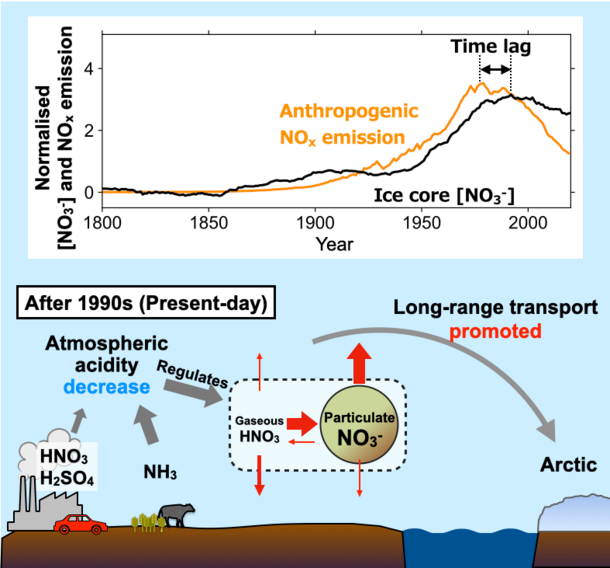
Figure: Changes in nitrate levels (black) reconstructed from ice cores and anthropogenic nitrogen oxide (NOx) emissions (orange) from surrounding countries between 1800 and 2020 (values normalized to the 1800–1850 baseline). The observed time lag is explained by variations in the efficiency of long-range transport of atmospheric nitrate, which depends on atmospheric acidity.
*1: Ice core
A cylindrical sample of ice drilled vertically from polar ice sheets.
*2: Atmospheric nitrate
Nitrate, a type of nitrogen oxides, exists in the atmosphere in gas form (HNO3) or particulates (NO3-) bound to other cations. Atmospheric nitrate is removed from the atmosphere by rain and turbulence and is deposited to the biosphere, such as the oceans and forests.
*3: Nitrogen oxides (NOx)
A collective term for nitrogen oxides, including nitric oxide (NO) and nitrogen dioxide (NO2). NOx is primarily emitted from human activities such as factory smoke and automobile exhaust. When further oxidized in the atmosphere, it forms atmospheric nitrate. NOx has harmful effects on human health and the environment, contributing to conditions such as respiratory disease, acid rain, PM2.5 pollution, and eutrophication of river basins.
Journal:Nature Communications
Researcher's Information:Sakiko Ishino
 PAGE TOP