




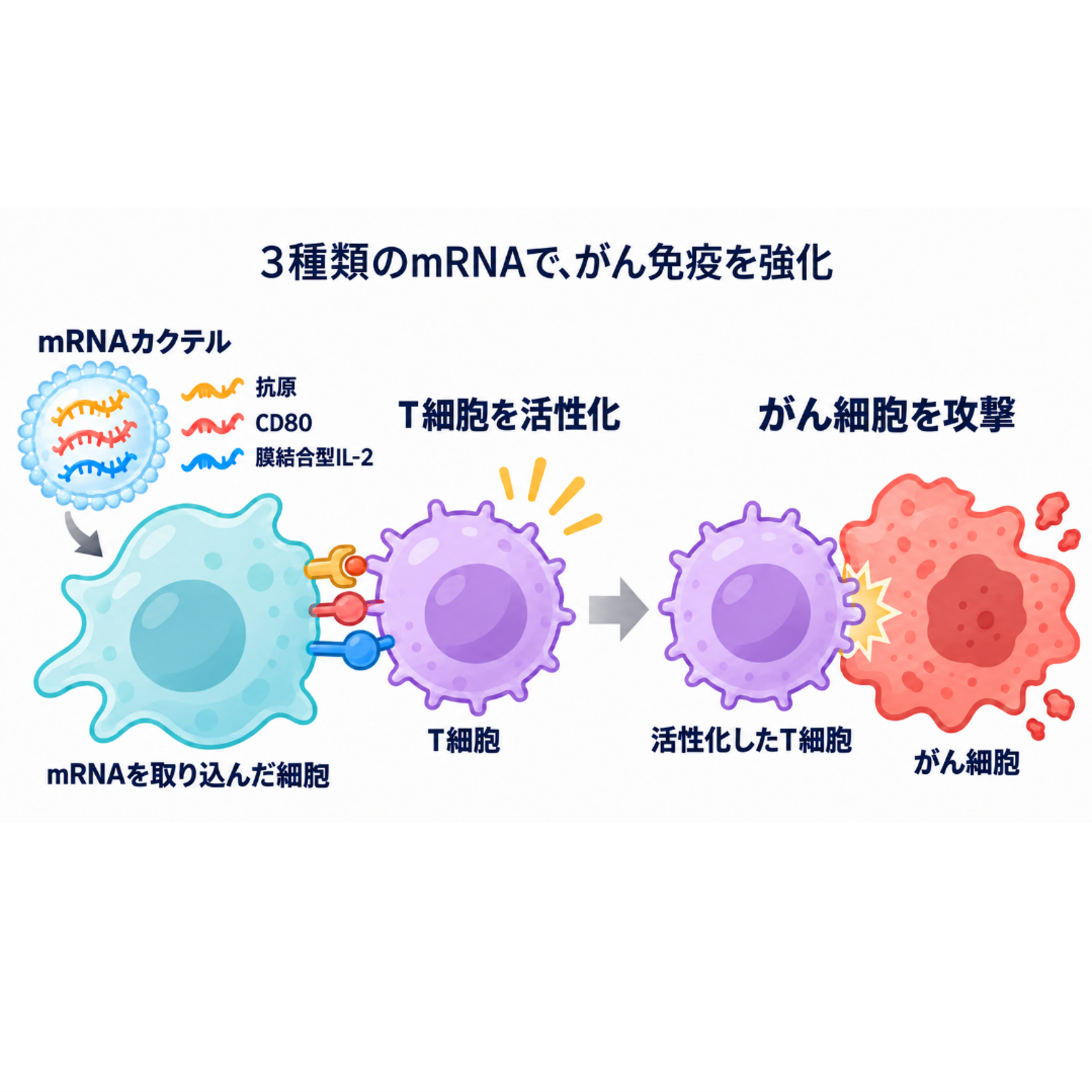
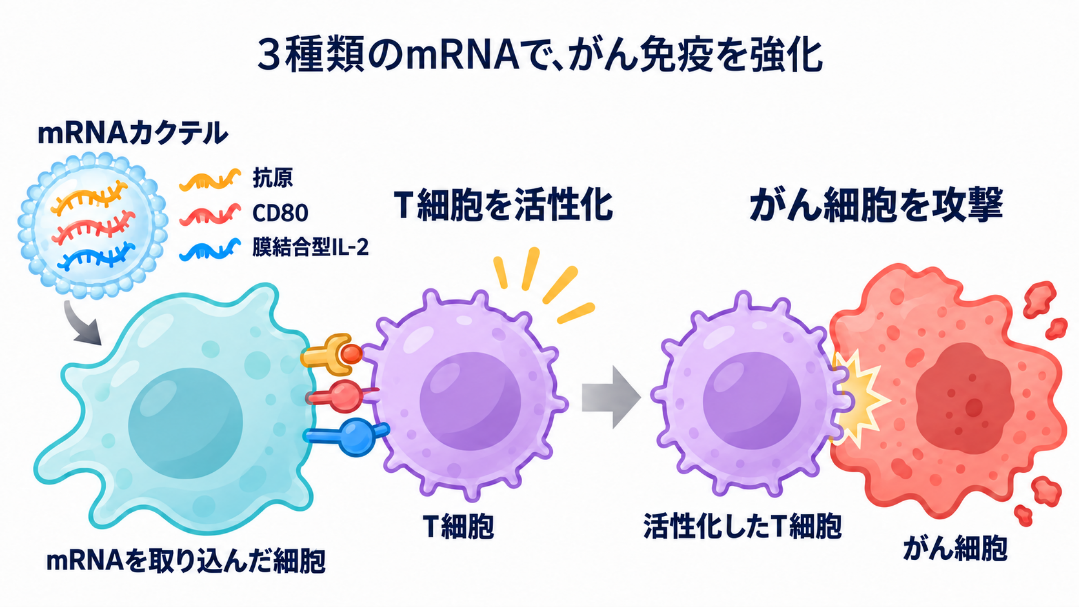
A research team led by Associate Professor Tomoyoshi Yamano, Professor Rikinari Hanayama, and Toan Van Le, a postdoctoral researcher at Kanazawa University and a 2026 graduate of the WISE Program for Nano-Precision Medicine, Science and Technology, from the Faculty of Medicine, Institute of Medical, Pharmaceutical and Health Sciences, Kanazawa University, and the Nano Life Science Institute (WPI-NanoLSI), in collaboration with the Institute of Tropical Medicine, Nagasaki University, has developed a modular mRNA cocktail that combines three types of mRNA encoding a tumor antigen, a costimulatory molecule, and a cytokine, and successfully demonstrated its ability to synergistically activate T cells specific for cancer antigens.
mRNA vaccines (*1) have achieved remarkable success in the fight against COVID-19 and are now being actively explored for cancer immunotherapy. However, tumor antigens expressed by cancer cells are often poorly recognized as foreign by the immune system, meaning that administration of antigen-encoding mRNA alone frequently fails to elicit sufficiently strong immune responses. To address this challenge, the research team designed a strategy that combines antigen-encoding mRNA with two additional mRNAs: one encoding the costimulatory molecule CD80 (*2), which provides a second activation signal to T cells, and another encoding a membrane-anchored cytokine (*3) that remains tethered to the cell surface. By delivering these three mRNAs simultaneously, the researchers aimed to provide the key signals required for robust T-cell activation.
As a result, the number of antigen-specific cytotoxic T cells (CD8-positive T cells) in mice increased to more than twice that achieved with tumor antigen mRNA alone, leading to suppression of tumor growth and prolonged survival. Furthermore, when the researchers replaced IL-2 with IL-12 as the cytokine component and redesigned the tumor antigen to be presented through the MHC class II pathway, the same platform successfully induced helper T cells (CD4-positive T cells) to differentiate into Th1 cells (*4). When the two formulations were administered in combination, complete tumor regression was observed in multiple animals, which also showed resistance to tumor re-challenge. In addition, the researchers demonstrated that the platform could induce cytotoxic T cells specific for the cancer antigen NY-ESO-1 (*6) in transgenic mice expressing the human HLA-A02:01 molecule (HLA-A*02:01 transgenic mice, *5). These findings provide an important foundation for future clinical applications.
This research is expected to contribute to the development of “programmable cancer vaccines,” whose composition can be tailored to the unique characteristics of an individual patient's cancer.
The findings were published in the online edition of the open-access international journal "OncoImmunology" on September 22, 2026.
【Glossary】
*1 mRNA Vaccine
A vaccine that uses messenger RNA (mRNA) to instruct the body's cells to produce an antigen and stimulate an immune response. This technology was successfully used in COVID-19 vaccines and is now being investigated for applications in cancer immunotherapy and infectious diseases.
*2 Costimulatory Molecule CD80
CD80 is a molecule expressed on the surface of antigen-presenting cells. By binding to CD28 on T cells, it provides a "second signal" required for T-cell activation. Antigen recognition alone is not sufficient for full T-cell activation; without this additional signal, T cells may become unresponsive rather than activated.
*3 Membrane-Anchored Cytokine
Cytokines such as IL-2 and IL-12 are fused to a portion of a cell membrane protein (in this study, the extracellular domain of CD8α) and anchored to the cell surface. The aim is to prevent the cytokines from diffusing throughout the body and to ensure they act only in the vicinity of cells presenting antigens.
*4 Th1 cells
Th1 cells are a subset of helper T cells that produce interferon-gamma (IFN-γ) and support the activity of cytotoxic T cells and macrophages. Their differentiation is regulated by the transcription factor T-bet, and they play an important role in anti-tumor immune responses.
*5 HLA-A*02:01 transgenic mice
HLA-A*02:01 transgenic mice are genetically engineered mice that express components of the human major histocompatibility complex (MHC) molecule HLA-A*02:01. They enable researchers to evaluate T-cell responses based on antigen presentation mechanisms similar to those found in humans.
*6 NY-ESO-1
NY-ESO-1 is a member of the cancer-testis antigen family that is expressed in a wide range of cancers but is normally restricted to a limited number of healthy tissues, such as the testis. Because human immune responses against NY-ESO-1 have been extensively characterized, it is considered one of the most important targets for cancer immunotherapy.
Click here for details on our research【Japanese Only】
Journal : OncoImmunology
Researcher Information : Tomoyoshi Yamano
Rikinari Hanayama
Related Information
Nano Life Science Institute, Kanazawa University (WPI-NanoLSI)
 PAGE TOP