





Expanding the Frontiers of Life Science with High-Speed Atomic Force Microscopy (High-Speed AFM)
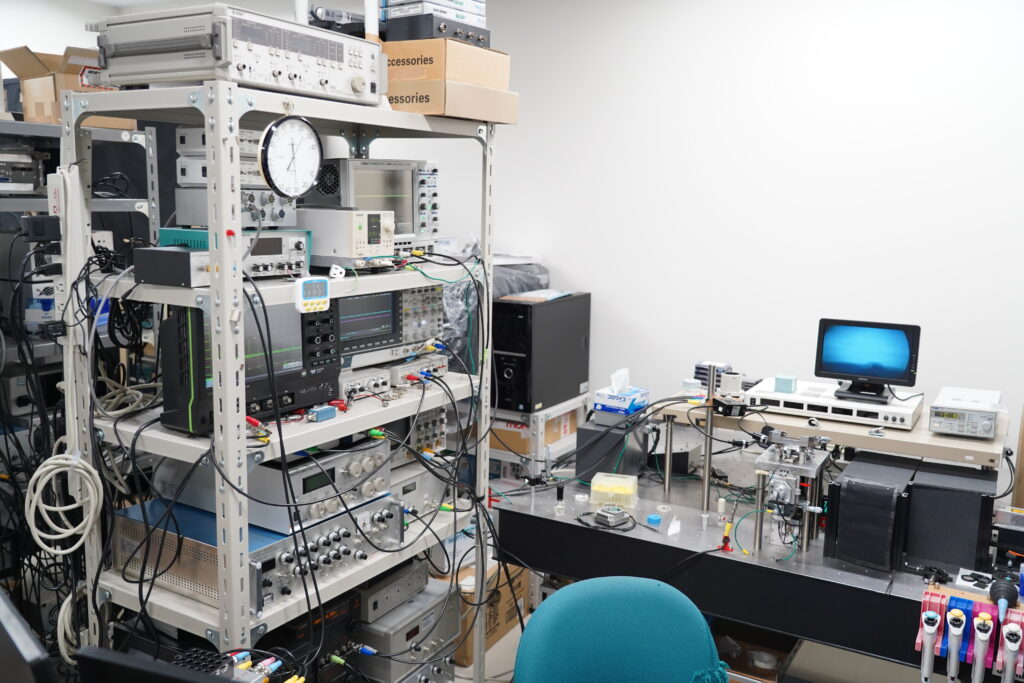
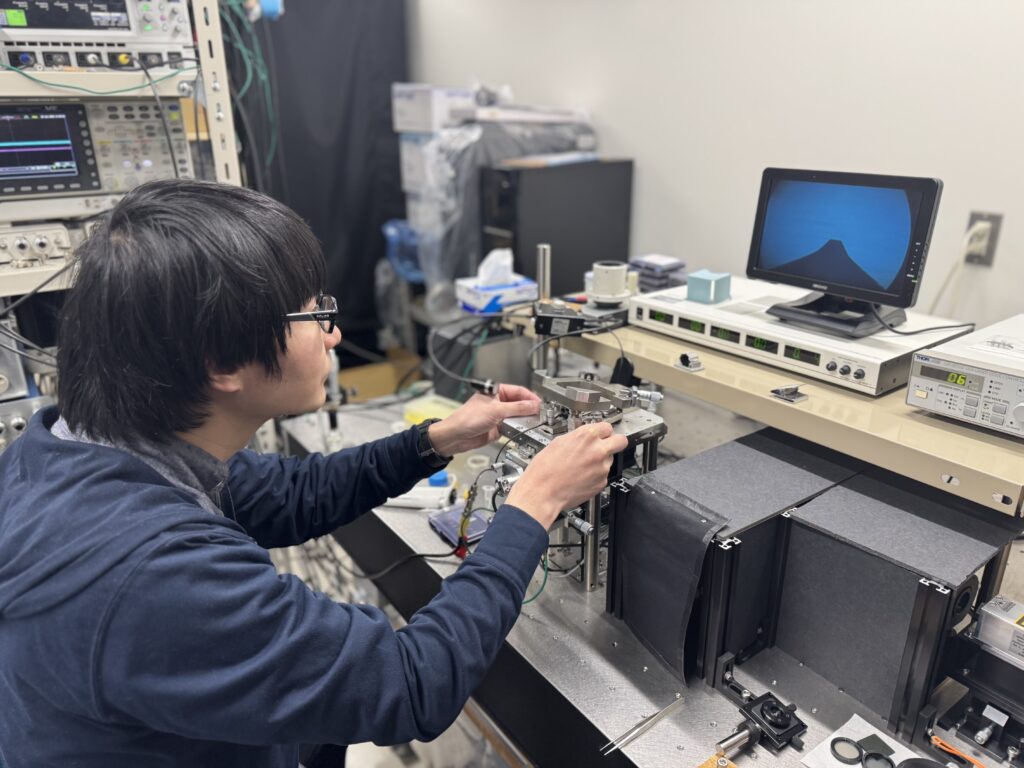
Assistant Professor Shingo Fukuda of the Nano Life Science Institute (NanoLSI) at Kanazawa University is driven by a desire to see the molecules at work inside living cells in greater detail. Inside living cells, a wide variety of tiny molecules work to sustain life. Observing how these molecules move and behave can provide clues to understanding what is happening inside our bodies. Yet conventional microscopy has faced a fundamental challenge: when researchers tried to observe molecular movements, it was difficult to see their structures clearly, while focusing on structural details made it difficult to capture movement. High-Speed Atomic Force Microscopy (High-Speed AFM) has helped overcome this challenge. It makes it possible to observe both the structure and movement of molecules at the same time and capture their behavior as real-time movies. Asst. Prof. Fukuda is working to further advance this “seeing” technology and capture molecules that have previously been beyond our view. “Being able to observe molecules in real time, whether in water or even in a vacuum, was a major breakthrough. Kanazawa University has been at the forefront of this development,” says Asst. Prof. Fukuda. High-Speed AFM was brought into practical use through the research and development of Toshio Ando, Professor Emeritus and Distinguished Professor at Kanazawa University, and his colleagues at the Nano Life Science Institute. Asst. Prof. Fukuda has also worked on High-Speed AFM research under Ando’s guidance. Now, Asst. Prof. Fukuda is taking on the challenge of further expanding what High-Speed AFM can reveal.

Further Advancing the Technology for Capturing Molecular Movements
Despite the remarkable capabilities of High-Speed AFM, Asst. Prof. Fukuda believes there is still significant room for improvement. “There are still many challenges,” he says. Recent advances have dramatically increased imaging speed. However, spatial resolution—the ability to distinguish fine structural details—has improved much more slowly. Although researchers can now observe molecular structures and movements simultaneously, many details still remain beyond reach. At the Nano Life Science Institute (WPI-NanoLSI), researchers pursue both the development of High-Speed AFM technologies and scientific studies that use them. This creates a powerful cycle: new technologies enable new discoveries, while those discoveries raise new questions that inspire further technological advances. Within this environment, Asst. Prof. Fukuda has developed scanning techniques that reduce stress on samples, allowing delicate biological specimens to be observed with less damage. His current goal is to further improve spatial resolution and reveal even finer structural details than can be seen today. When researchers gain the ability to see something that was previously hidden, new questions inevitably emerge. Those questions, in turn, drive the next generation of technological advances. High-Speed AFM continues to evolve through this process of scientific exploration, and Asst. Prof. Fukuda remains at the forefront of that effort.
Making the Invisible Visible—and Looking Beyond
For Asst. Prof. Fukuda, improving High-Speed AFM is about far more than simply making tiny molecules visible. It is a challenge to observe the extraordinarily complex molecular networks that underpin life. As imaging technologies continue to advance, researchers may uncover molecular activities and interactions that have never been observed before. Looking deeper into the microscopic world can ultimately lead to a deeper understanding of life itself. Making the invisible visible opens up new possibilities for future research and discovery. In this sense, Asst. Prof. Fukuda’s work is helping lay the groundwork for scientific breakthroughs that have yet to be imagined.
Using the instruments he has helped advance, Asst. Prof. Fukuda aims to make measurements that only he can make and capture biological phenomena that no one has ever seen before. The pursuit of something entirely new—and the excitement of discovering what no one has seen before—continues to drive his research today.
(Written by KUSUNOKI, Hirokazu)
Related Information
Nano Life Science Institute (WPI-NanoLSI)
 PAGE TOP