




A research group led by Professor Masaaki Nishiyama of the Institute for Frontier Science Initiative / Faculty of Medicine, Institute of Medical, Pharmaceutical and Health Sciences, Kanazawa University, together with Postdoctoral Researcher Kenta Nitahara (at the time of research; currently Postdoctoral Researcher at Kyushu University) and Assistant Professor Atsuki Kawamura (at the time of research; currently Postdoctoral Researcher at the University of California, Berkeley), has demonstrated for the first time in a mouse model that mutations in CHD8 (*1), a known autism spectrum disorder (ASD)–associated gene, cause abnormal differentiation of ventral neural progenitor cells during fetal development, leading to autism-like behaviors in adulthood.
Developmental disorders, including autism, present various challenges in daily life. With the increasing number of affected individuals, these disorders have become an important issue not only for patients and families but also for society as a whole. Recent epidemiological studies have revealed that CHD8 mutations occur with particularly high frequency among autism-associated genes, drawing significant attention. However, it has remained unclear when, where, and which cells are responsible for the onset of autism symptoms caused by CHD8 mutations.
Using a mouse model in which CHD8 mutations can be induced at specific developmental stages or in specific cell types, the research group investigated the conditions under which autism-like behaviors emerge. They found that when CHD8 mutations occur during mid-gestation, mice exhibit autism-like behaviors such as altered social interactions and anxiety-like behavior. Further detailed analyses revealed that CHD8 mutations cause premature differentiation of ventral neural progenitor cells (*2) in the fetal brain. These progenitor cells give rise to inhibitory neurons (*3) and oligodendrocytes (*4), and abnormalities in their differentiation lead to disrupted neural circuit networks in the adult brain.
More detailed analyses further showed that restoring CHD8 expression during mid-gestation ameliorates autism-like behaviors in the mouse model. These findings identify the critical developmental period and responsible cell types involved in autism onset and suggest the possibility of therapeutic intervention during development. This research is expected to contribute to elucidating the mechanisms of autism onset during brain development and to the development of new treatment strategies.
The results of this study were published online in "Nature Communications", an international scientific journal, at 6:00 p.m. (JST) on May 27, 2026.
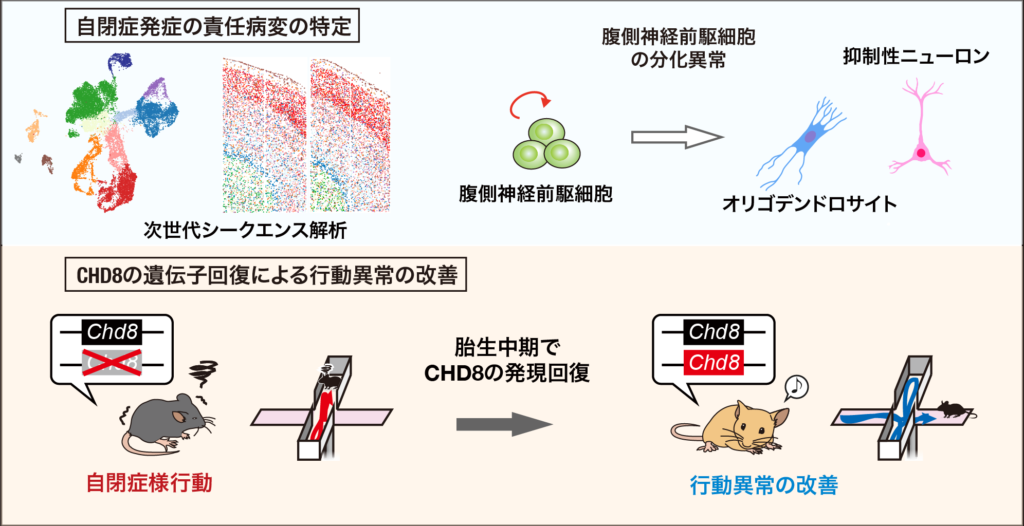
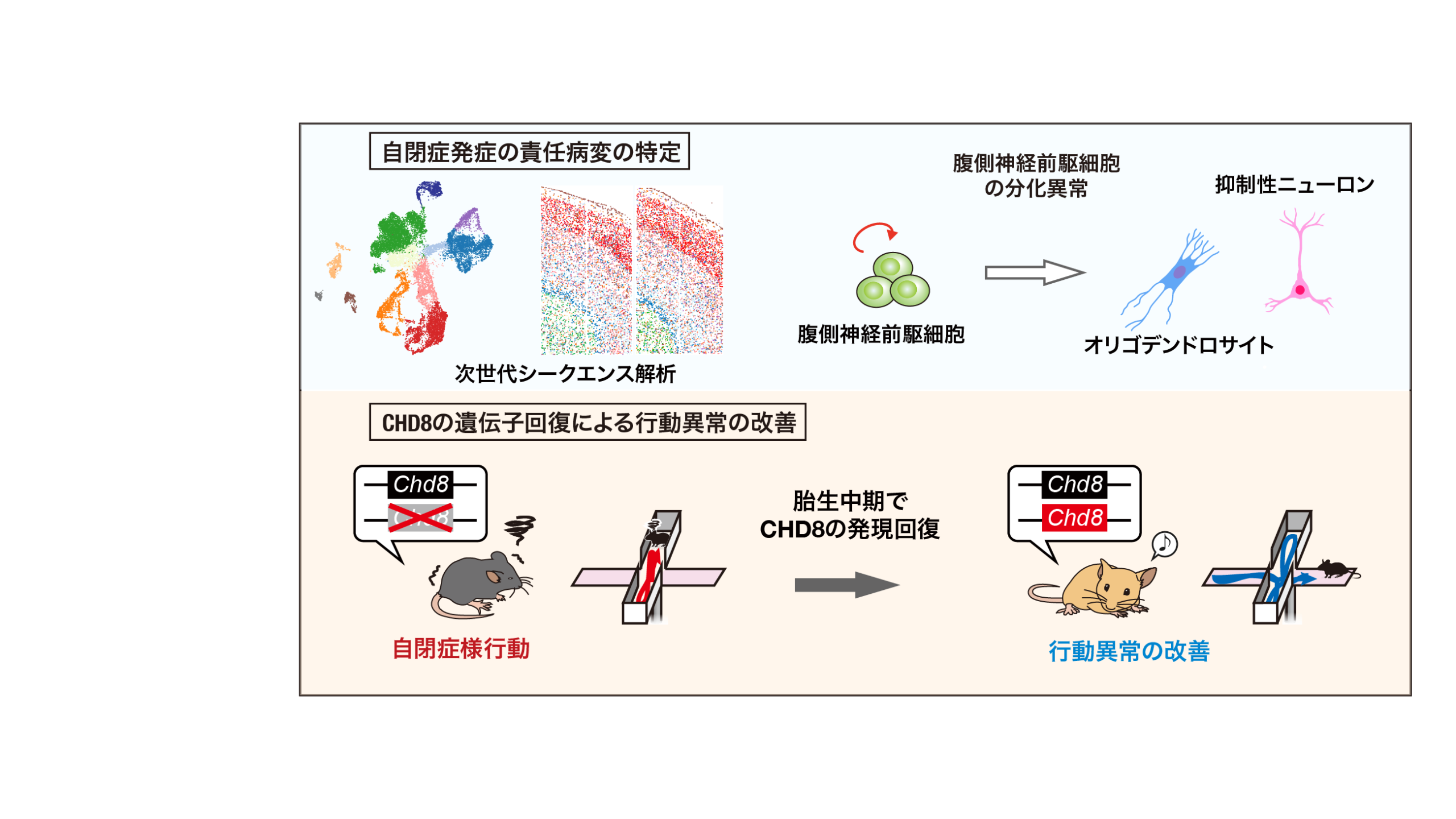
Figure:Elucidation of Autism Onset Mechanisms Caused by CHD8 Mutations and Therapeutic Applications
The research group conducted next-generation sequencing analyses of cells carrying CHD8 mutations during mid-gestation and discovered that abnormalities in the differentiation of ventral neural progenitor cells into oligodendrocytes and inhibitory neurons are closely associated with the onset of autism-like behaviors (upper figure). Furthermore, restoring CHD8 expression during mid-gestation in the ASD model mice improved behavioral abnormalities (lower figure). These findings are expected to contribute to understanding autism pathology and developing therapeutic applications.
*1 CHD8
CHD8 stands for Chromodomain Helicase DNA-binding protein 8, a member of the chromatin remodeling factors that use intracellular energy to alter chromosomal structure and regulate gene expression.
*2 Ventral Neural Progenitor Cells
Undifferentiated cells present during brain development that have the potential to differentiate into neurons and glial cells. Neural progenitor cells in the ventral brain region give rise to inhibitory neurons and oligodendrocytes, which play essential roles in regulating neural circuit function.
*3 Inhibitory Neurons
Neurons that suppress the activity of other neurons within neural circuits. They primarily use the neurotransmitter GABA to prevent excessive excitation and maintain balanced information processing in the brain.
*4 Oligodendrocytes
A type of glial cell found in the brain and spinal cord that forms the myelin sheath surrounding neuronal axons. The myelin sheath increases the conduction speed of neural signals and is essential for proper neural circuit function.
Click here to see the press release.【Japanese only】
Journal:Nature Communications
Researcher's Information:Masaaki Nishiyama
Related Information
Institute for Frontier Science Initiative, Kanazawa University
 PAGE TOP