




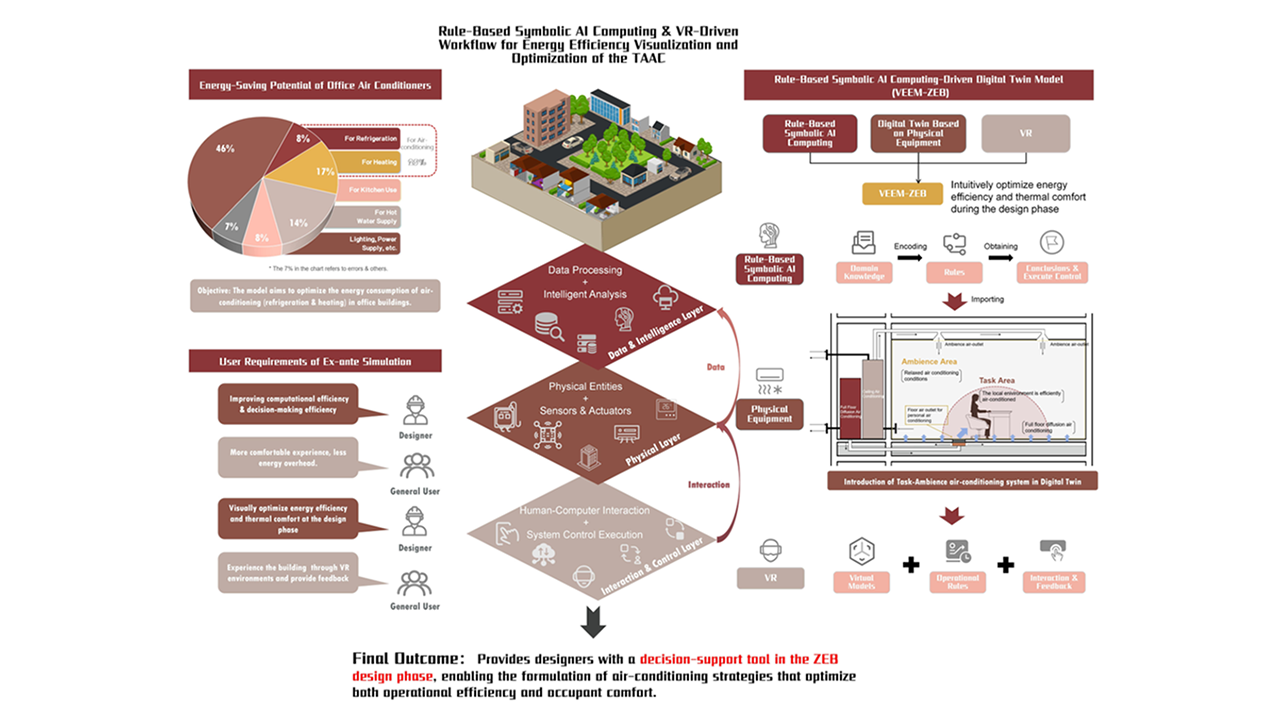
A research team led by Assistant Professor Xiao Teng of the Faculty of Transdisciplinary Sciences for Innovation, Institute of Transdisciplinary Sciences for Innovation, Kanazawa University, in collaboration with Professor Zhenjiang Shen (Cooperative Chair in Spatial Planning, Graduate School of Natural Science and Technology; also Research Collaborator, Institute of Transdisciplinary Sciences for Innovation) and Yuntian Zhang, a doctoral student in the Division of Geosciences and Civil Engineering, Graduate School of Natural Science and Technology, has developed VEEM‑ZEB, a next‑generation building‑energy evaluation model that integrates rule‑based symbolic AI computation with VR technology.
This model enables real‑time visualization and simultaneous evaluation of both the energy‑saving performance of Task-Ambience air conditioning (TAAC) (*2) and indoor thermal comfort during the design phase of Zero-energy building (ZEB) (*1).
With global decarbonization accelerating, reducing energy consumption in the building sector has become an urgent challenge. In Japan, achieving ZEB standards for all new buildings by 2030 is a national goal; however, until now, there have been few tools capable of intuitively assessing the effectiveness of air‑conditioning systems during the design stage.
In this study, the team developed a novel evaluation method that integrates thermal‑comfort analysis with energy‑load assessment. They also created a VR‑based design‑support environment that allows designers to dynamically modify design conditions and simultaneously examine both energy efficiency and occupant comfort. As a result, the introduction of TAAC was shown to reduce annual air‑conditioning energy consumption by an average of 7.62%.
This method enables designers to select the optimal air‑conditioning system before construction, supporting building designs that achieve both decarbonization and comfort. The findings are expected to serve as a foundational technology for next‑generation smart‑building design.
The results of this research were published in the international journal "Sustainable Cities and Society" on November 15, 2025 (UK time).
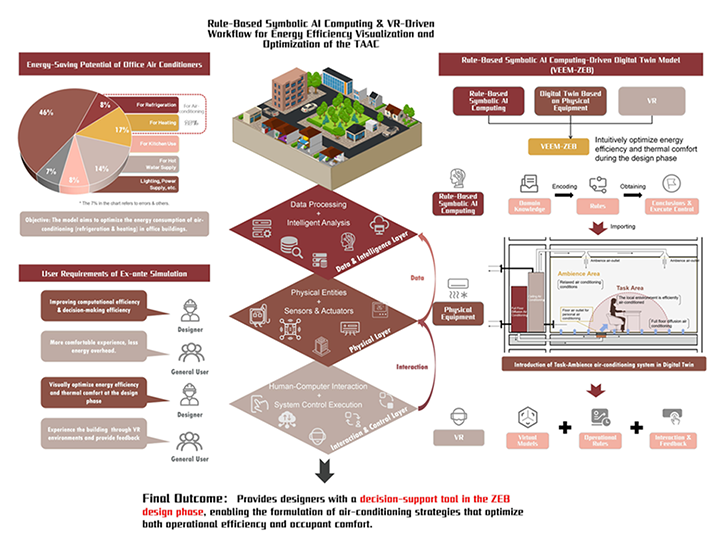
Figure1: Digital‑twin evaluation framework for visualizing the design‑stage energy performance of Task-Ambience air conditioning (TAAC) in Zero-energy building (ZEB).
【Glossary】
*1 Zero-energy building (ZEB)
A building that aims to achieve virtually zero annual primary energy consumption.
*2 Task-Ambience air conditioning (TAAC)
An air conditioning system that controls the work area (task) and the surrounding space (ambience) separately.
Click here to see the press release【Japanese only】
Journal : Sustainable Cities and Society
Researcher Information : Teng Xiao
Related Information
College of Transdisciplinary Sciences for Innovation, Kanazawa University
Graduate School of Natural Science and Technology, Kanazawa University
 PAGE TOP