
Students' Sparks

Challenging Unknown Theories of AI Driven by Natural Phenomena

Division of Mathematical and Physical Sciences, Graduate School of Natural Science and Technology, Doctoral course
中村 優真NAKAMURA,Yuma

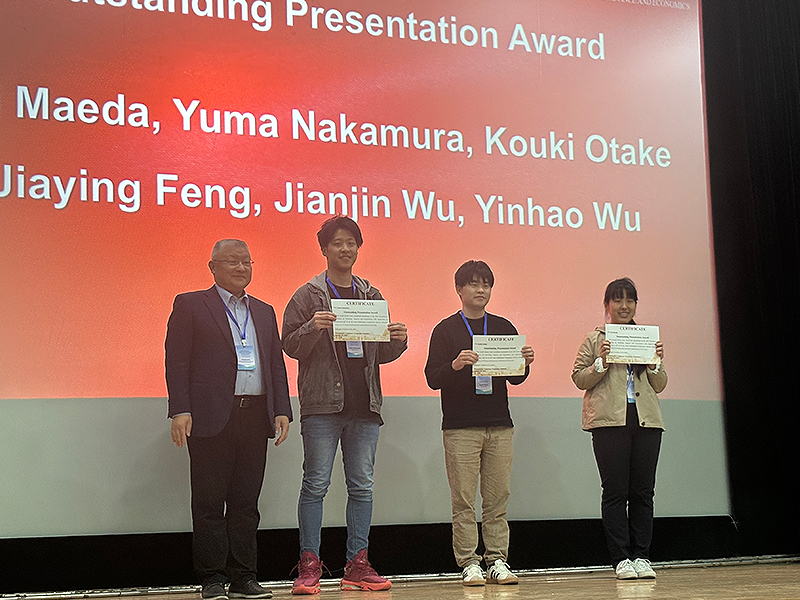
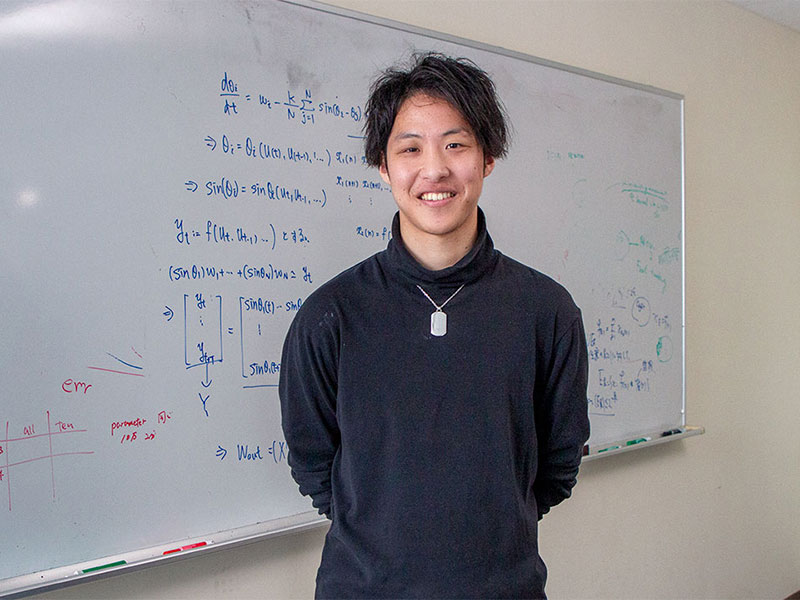
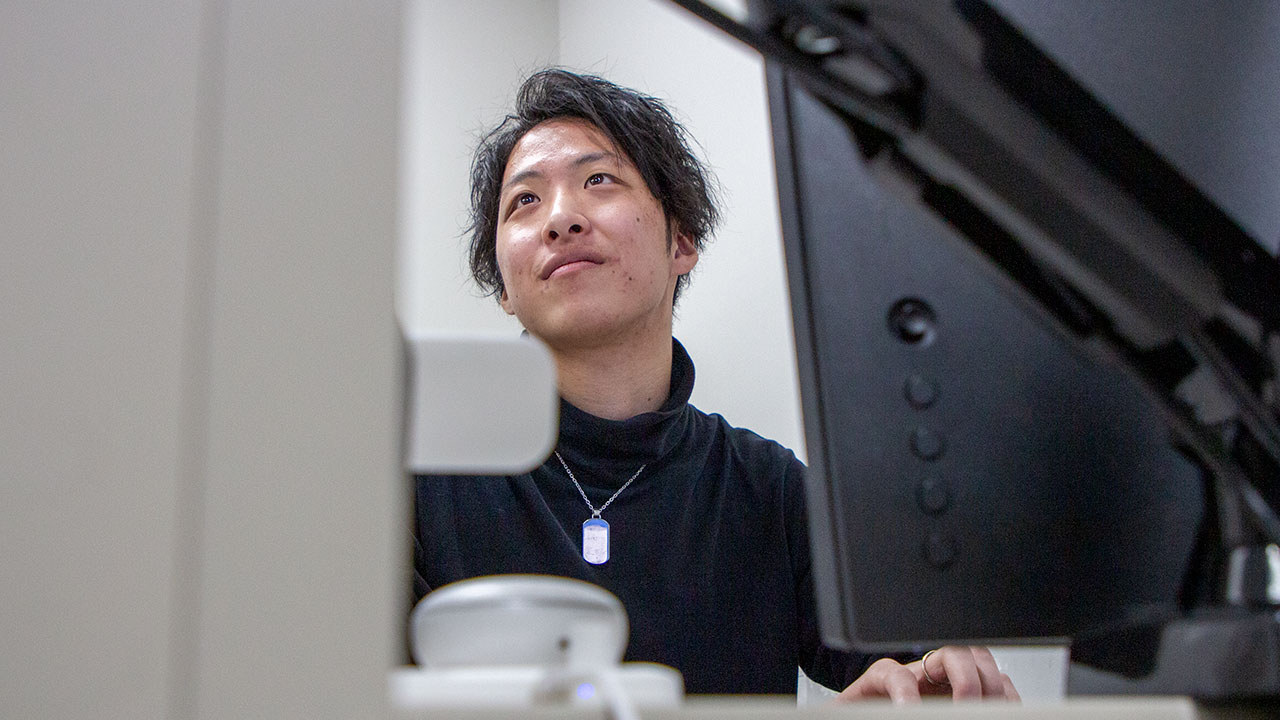
We interviewed  Yuma Nakamura, a second-year doctoral student (at the time of the interview) in Division of Mathematical and Physical Sciences, Graduate School of Natural Science  and Technology. As a HaKaSe +selecte d student, he is diligently engaged in theoretical research on reservoir computation. We  interviewed  him  about the apeeal of the doctoral program and the rewards of research. For video of the interview, please click the official research Instagram.

Please tell us why you decided to enter the doctoral course.

The research I was engaged in during my Master's program was very interesting, and the main reason for pursuing a doctoral degree was that I wanted to continue this research. I also wanted to improve my ability to discuss and write papers in English. There are many international students at Kanazawa University, and my opportunities to use English increased significantly, especially during the doctoral course.

In a sense, research is a "battle against oneself”. There are parts that are discussed with the people around you, but in the end, it is a process of thinking things through by yourself. While my friends who graduated from bachelor's and master's programs are working as professionals, I sometimes feel the difference in my position as a student, but I decided to go on to higher education because I see it as a time to develop my skills as a researcher.

What kind of research are you currently conducting?

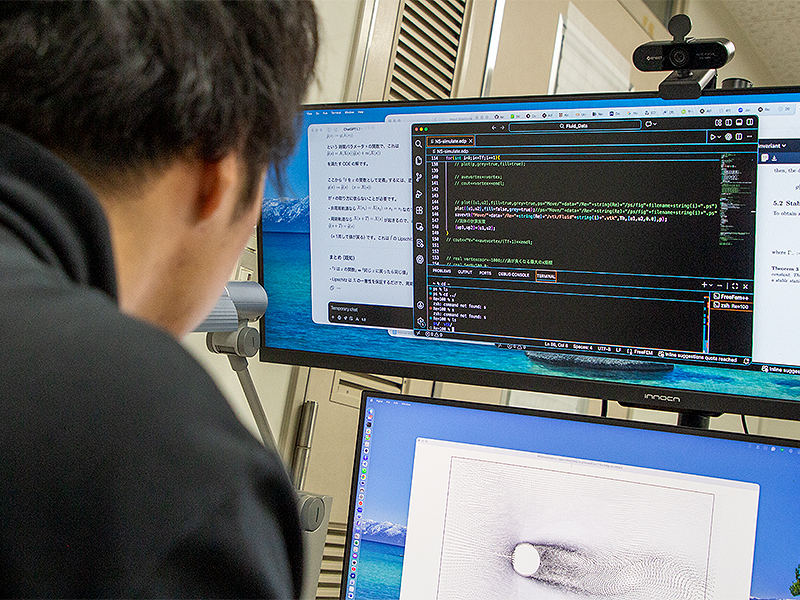
I am working on developing a theory in the field of "reservoir computation." In recent years, AI (Artificial Intelligence) and machine learning have been used in various fields, but these technologies consume very large amounts of power. Reservoir computation has been proposed as one of the methods to solve this problem. What is unique about this method is that it is based on the idea of replacing the enormous amount of calculations that have been performed by computers with natural physical phenomena such as the flow of water or the movement of air, which can predict data and realize highly accurate artificial intelligence. To use a simpler analogy, the flow of water can be used to calculate the stock price of a company or to predict the weather at a particular location. The fascination of this research lies in the new possibilities created by the unusual combination of "physical phenomena" and "artificial intelligence".

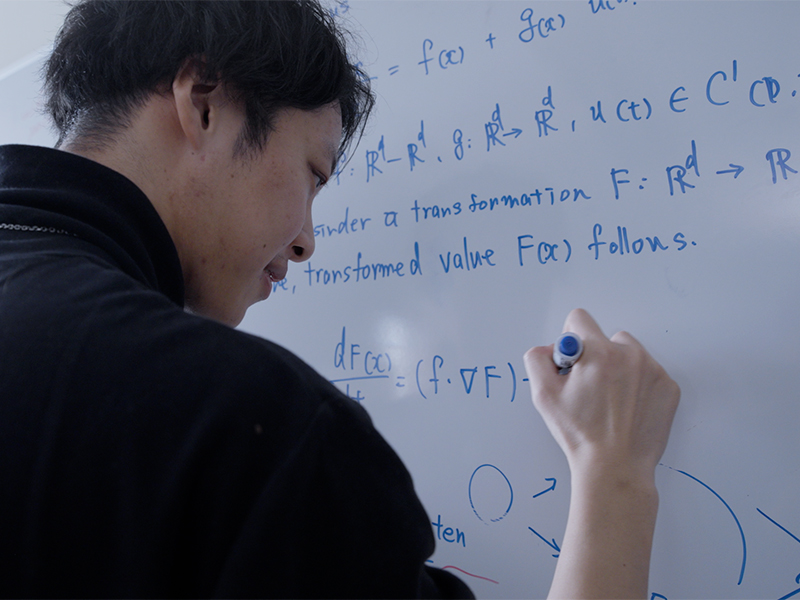
Although research can be conducted anywhere with a computer, I go to the laboratory almost every day. My style is to think while writing mathematical formulas on a large whiteboard, and I also enjoy the environment where I can immediately consult with my supervisor if I have any questions.

How did you come across this research?

When I was in my third year of the bachelor's program, I learned about the research of my current advisor, Professor Hirofumi Notsu. I was strongly attracted to his research on reservoir computation using water and air flow, and contacted him directly, asking him to let me do research. Until then, I had studied the field of engineering at a university in Hakodate, majoring in information science, but now I am engaged in research focusing on basic mathematical theory.

What skills or experiences have you gained through HaKaSe+?

My ability to speak and write in English has improved considerably compared to when I was in the Master's program. In the laboratory, discussions are often held in English, and I was able to train them through the exchange of explaining the theories I developed and receiving feedback. Not only that, but I feel that I also acquired the ability to think logically and the "mental stamina" to finish my research without giving up. The support for research expenses has also been very helpful. Submitting a paper can cost an enormous amount of money through various processes, so the support has greatly expanded the scope of my research activities.

Finally, what are your dreams for the future?

In the future, I would like to remain in academia and continue my current research, aiming to become a researcher and university faculty member who can convey the fun of mathematics and theoretical research. People tend to have the image that mathematics is difficult and that they are not good at it, but there is a very fascinating world behind it.

For me, the real thrill of research lies in the process of confronting a situation alone, without even seeing the goal, and arriving at a conclusion known only to myself. Research in mathematics is also an activity that is passed down from generation to generation, as many things are not clarified in our lifetime. That is why what kind of process is more important than the final result. Even if we try various methods and they don't work, we see it as a great harvest to reach that conclusion.

Research is often compared to climbing a mountain. There are many routes to the top, each with a different view. Unlike real mountains, however, we do not know which route is easy. You climb, you get stuck, you explore another route, you get stuck again, and so on. Still, the motivation to enjoy the research always prevails.

*All affiliations, grades, years, etc. are current at the time of the interview. Please note that all affiliations, grades, and years are current at the time of interview.

(Tamayo Kido, writer)

FacebookPAGE TOP