




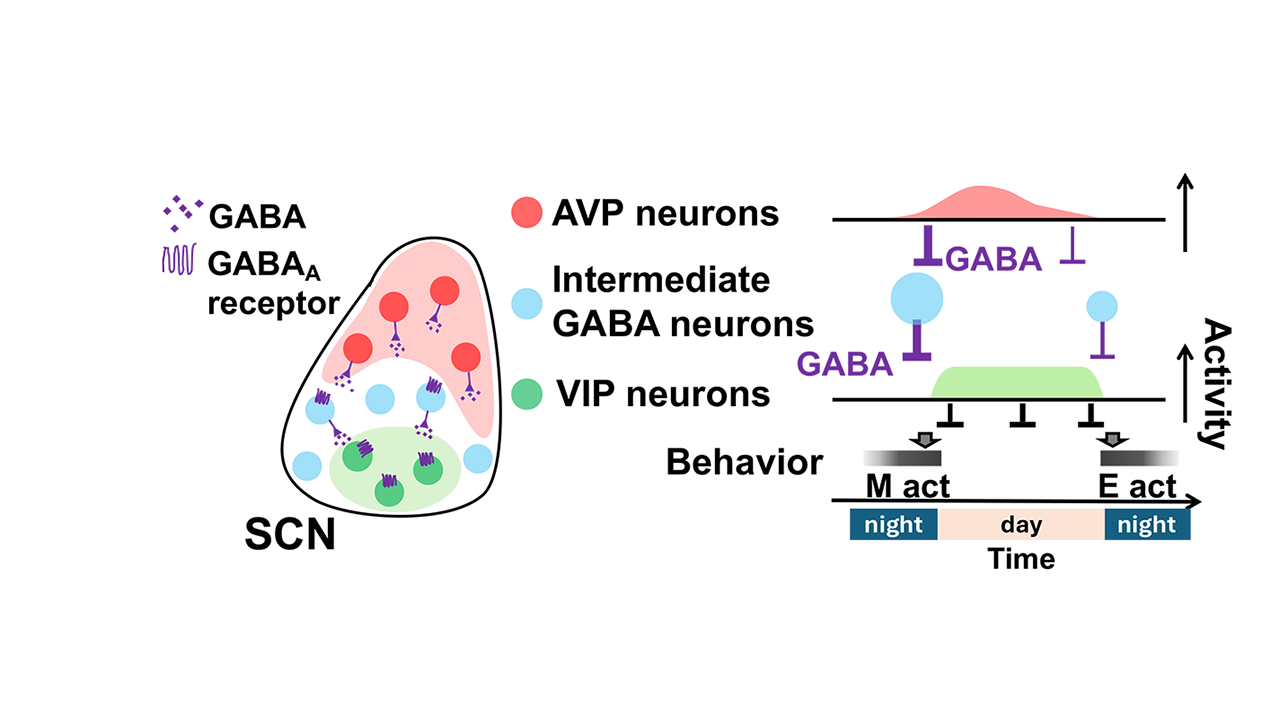
A research group led by JSPS Postdoctoral Fellow Yubo Peng; Assistant Professor Yusuke Tsuno; and Professor Michihiro Mieda of the Faculty of Medicine, Institute of Medical, Pharmaceutical and Health Sciences, Kanazawa University, has revealed how GABA neural networks in the suprachiasmatic nucleus, the central circadian clock of the body, control the timing of daily activity.
Mammals, including humans, have circadian rhythms in which sleep, behavior, body temperature, hormone secretion, and other functions fluctuate on an approximately 24-hour cycle. These rhythms are generated by the suprachiasmatic nucleus in the hypothalamus, which not only keeps an approximately 24-hour cycle but also helps determine when during the day an organism is active. However, the specific neural circuits within the suprachiasmatic nucleus that regulate the timing of behavior and sleep have not been fully understood.
In this study, the researchers focused on GABA (*3)-mediated signaling in the suprachiasmatic nucleus from arginine vasopressin (AVP, *1)-producing neurons to vasoactive intestinal polypeptide (VIP, *2)-producing neurons. They found that changes in the balance of this neural circuit alter the timing of animals’ behavioral rhythms and the distribution of time between active and resting phases, without affecting the approximately 24-hour cycle itself.
This is an important finding for understanding how the body’s internal clock shapes the time structure of daily life.
Human sleep and wakefulness rhythms cannot be freely changed by willpower alone; they are precisely regulated by the brain’s internal clock circuits. This study suggests that such neural circuits may underlie everyday experiences such as being unable to fall asleep right away despite trying, or having difficulty maintaining a regular daily rhythm. These findings are expected to contribute to the future prevention and treatment of sleep disorders and other diseases and health problems caused by disruptions of the body clock.
The findings were published online in the U.S. scientific journal PLOS Biology on March 9, 2026.
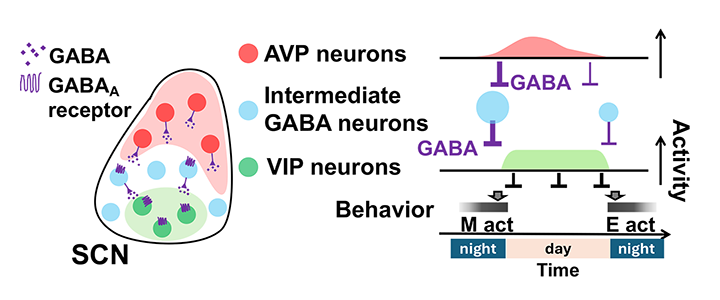
Figure 1: Model of how the GABAergic neural network from AVP-producing neurons to VIP-producing neurons in the suprachiasmatic nucleus determines the timing of activity and rest in circadian behavioral rhythms.
Mice are nocturnal, and VIP-producing neurons are activated during the resting phase, which occurs during the day. GABA released from AVP-producing neurons reduces inhibition of VIP-producing neurons via intermediate GABAergic neurons, a process known as disinhibition. This effect is strong in the morning and relatively weak in the evening. This disinhibition enhances the activity of VIP-producing neurons, which is thought to help determine the timing of the end of spontaneous activity in the morning (Morning: M) and also influence the timing of activity onset in the evening (Evening: E).
Original figure: Peng Y. et al. (PLOS Biology, 2026). Modified by the authors under the CC BY 4.0 license. https://creativecommons.org/licenses/by/4.0
【Glossary】
*1 Arginine vasopressin (AVP)
A type of peptide that functions in the brain and body. AVP-producing neurons in the suprachiasmatic nucleus are located in the dorsal region and are involved in determining the period of the circadian clock.
*2 Vasoactive intestinal polypeptide (VIP)
A type of peptide involved in neurotransmission. VIP-producing neurons in the suprachiasmatic nucleus are located in the ventral region, receive information about environmental light, and play an important role in circadian clock entrainment and rhythm maintenance.
*3 GABA
One of the neurotransmitters widely used in the brain. In many cases, it acts to inhibit neuronal activity.
Click here to see the press release【Japanese only】
Journal : PLOS Biology
Researcher Information : Michihiro Mieda
Yusuke Tsuno
Related Information
School of Medicine, College of Medical, Pharmaceutical and Health Sciences / Graduate School of Medical Sciences, Kanazawa University : https://www.med.kanazawa-u.ac.jp/EN/index.html
Laboratory of Integrative Neurophysiology: https://sites.google.com/view/neurophysiol-kanazawa-u/
 PAGE TOP