




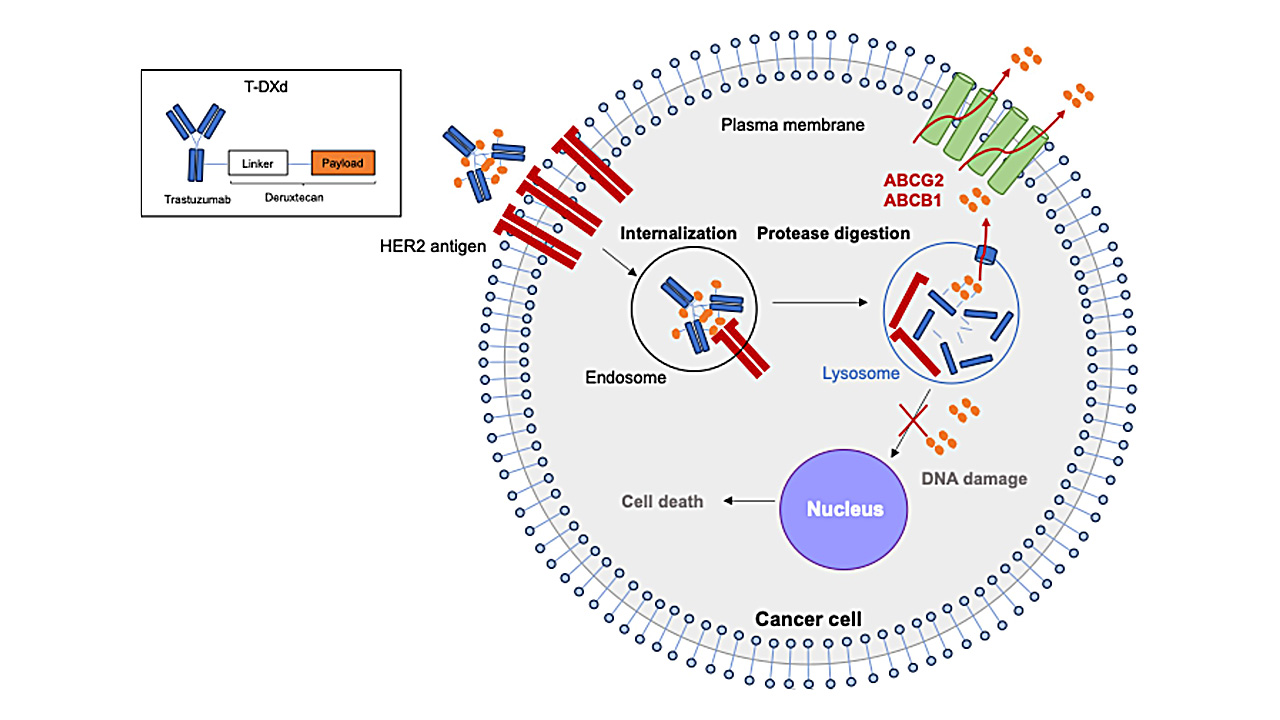
A collaborative research group including Professor Seiji Yano, Respiratory organ internal medicine, Faculty of Medicine, Institute of Medical, Pharmaceutical and Health Sciences, Kanazawa University, Assistant Professor Yuya Murase, Graduate School of Medical Sciences, and Professor Noriyuki Inaki, Gastrointestinal Surgery/Breast Surgery, Faculty of Medicine, Institute of Medical, Pharmaceutical and Health Sciences, has revealed that one of the main causes of the "acquired resistance'' that occurs during treatment with Trastuzumab deruxtecan (T-DXd) (*3), an antibody-drug conjugate (ADC) (*2) that targets HER2 (*1), is the mechanism by which cancer cells expel the drug outside the cell.
ADCs are drugs in which a cytotoxic anticancer drug (payload) is attached to an antibody that binds to a target antigen by a linker. T-DXd is an antibody targeting HER2 with an exatecan derivative (DXd) (*4), which has strong anticancer activity, as its payload. On the other hand, the molecular mechanism of resistance based on its complex structure has not been fully elucidated.
In this study, we examined the pathways to overcome resistance to T-DXd by classifying resistance mechanisms into four categories: target antigen-related resistance mechanisms, resistance mechanisms due to decreased cellular uptake, lysosome dysfunction, and payload-related resistance mechanisms. HER2-positive gastric cancer cell lines (N87) and lung cancer cell line (Calu-3) in an in vivo (*5) model, no decrease in expression of target antigens, no decrease in intracellular uptake of T-DXd, and no lysosomal dysfunction were observed.
On the other hand, increased expression of ABC transporter (ABCG2/ABCB1) (*6), which is involved in drug efflux, was shown to attenuate the anticancer effect of DXd. Furthermore, it was shown that the novel HER2-ADC BB1701 (Bliss Bio) in combination with an ABC transporter inhibitor and with eribulin (*7) as a payload was effective against a T-DXd-resistant model with high expression of ABCG2.
This research result is a report that clarified the important role of the ABC transporter in the resistance mechanism of T-DXd, and is expected to lead to the development of next-generation ADCs and optimization of therapeutic sequencing.
The results of this research were published online in "Cancer Science", the official journal of the Japanese Cancer Association, on January 27, 2026.
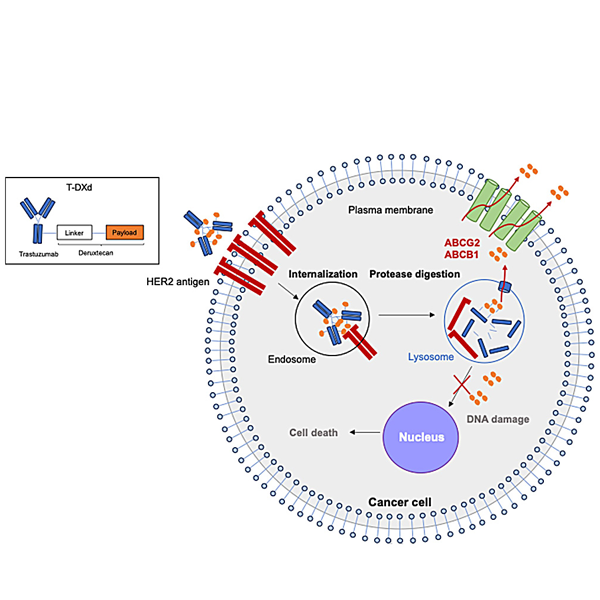
Mechanism of T-DXd resistance: DXd efflux by ABCG2/ABCB1
【Glossary】
*1 HER2
HER2 (Human Epidermal Growth Factor Receptor 2) is a receptor-type protein (receptor tyrosine kinase) that exists on the cell membrane. It is an important therapeutic target for breast cancer, gastric cancer, and other cancers.
*2 Antibody-drug conjugate (ADC)
Antibody-drug conjugate (ADC) is a drug in which a potent cytotoxic anticancer drug (payload) is linked to an antibody that binds to cancer cells. It is a therapeutic drug that aims to selectively deliver the drug to cancer cells that express the target molecule.
*3 Trastuzumab deruxtecan (T-DXd)
Trastuzumab deruxtecan (T-DXd) is a HER2-targeted ADC that combines a HER2-targeting antibody (trastuzumab) with a payload of deruxtecan (DXd), and is used to treat multiple HER2-positive cancer types. It is used for the treatment of multiple types of HER2-positive cancers.
*4 Exatecan derivative (DXd)
DXd (deluxecan) is a cytotoxic anticancer drug (payload) on T-DXd and is a derivative based on exatecan. It induces cancer cell death by damaging DNA primarily through topoisomerase I (TOP1) inhibition.
*5 In vivo (in vivo experiment)
An experiment conducted in a living organism (e.g., an individual animal). In contrast, in vitro is an experiment conducted in a test tube such as cultured cells.
*6 ABC transporters (ABCG2/ABCB1)
ABC transporters (ATP-binding cassette transporters) are a group of membrane proteins that pump intracellular substances out of cells using ATP energy. ABCG2 (BCRP) and ABCB1 (P-glycoprotein/MDR1) are known to be involved in drug resistance (multidrug resistance) by ejecting anticancer drugs out of cells.
*7 Eribulin
Eribulin is an anti-microtubule agent (cytotoxic anticancer drug) that interferes with cell division by inhibiting the function of microtubules. It is used in breast cancer and other types of cancer, and is sometimes used as a payload for ADCs.
Click here to see the press release【Japanese only】
Journal : Cancer Science
Researcher Information : Seiji Yano
Yuya Murase
Noriyuki Inaki
Related Information
School of Medicine, College of Medical, Pharmaceutical and Health Sciences・Graduate School of Medical Sciences, Kanazawa University : https://www.med.kanazawa-u.ac.jp/index.html
 PAGE TOP