




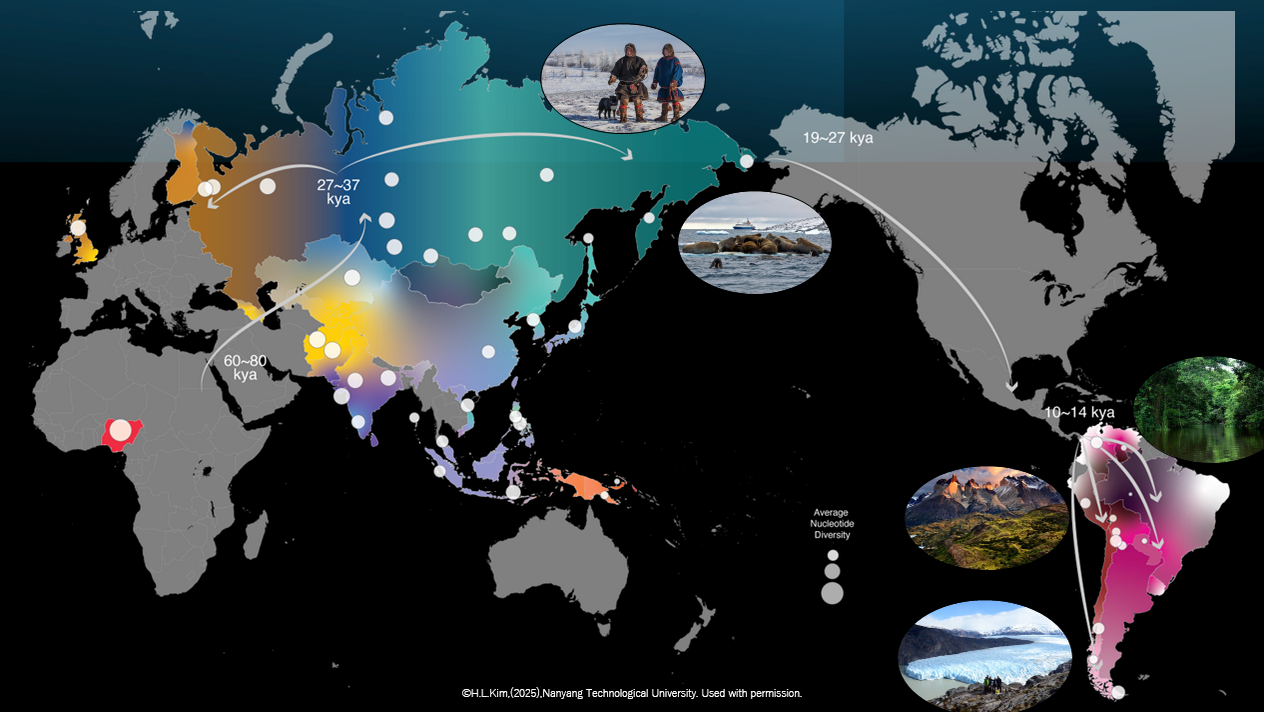
Professor Atsushi Tajima of the Faculty of Medicine / Sapiens Life sciences, Evolution and Medicine Research Center, Institute of Medical, Pharmaceutical and Health Sciences, Kanazawa University, together with Katsushi Tokunaga, Director of the Genome Medical Science Project at the National Center for Global Health and Medicine (now the Japan Institute for Health Security), and Associate Professor Hideyuki Tanabe of the Research Center for Integrative Evolutionary Science, SOKENDAI (The Graduate University for Advanced Studies), participated in an international genomics research project led by Nanyang Technological University in Singapore. This collaborative study revealed that ancient Asians undertook the longest human migration in prehistory, influencing the genetic diversity of populations in the Americas.
This study, supported by the GenomeAsia100K Consortium (*), analyzed genomic DNA sequence data from 1,537 individuals representing 139 diverse ethnic groups across Asia. A total of 48 researchers from 22 research institutions in Asia, Europe, and the United States participated in the project.
In this study, the researchers conducted a detailed analysis of the genetic information of Indigenous peoples in Eurasia and South America, revealing the migration routes taken by humans from Africa, through North Asia, and ultimately to Tierra del Fuego, the southernmost tip of South America. It was estimated that early settlers who reached northwestern South America approximately 14,000 years ago subsequently split into four major groups, each migrating to regions such as the Amazon and Patagonia. The study also suggests that genetic diversity decreased during this long‑distance migration, and that a reduction in the diversity of immune‑related genes may have contributed to vulnerability to infectious diseases introduced later. Furthermore, the research revealed that Asian populations possess greater genetic diversity than previously recognized, reaffirming their importance in genomic studies. These findings deepen our understanding of human evolution and genetic adaptation to the environment, and are expected to contribute to future advances in medicine and science.
The findings of this study were published in the U.S. scientific journal "Science" on May 15, 2025.

© H.L. Kim (2025), Nanyang Technological University. Used with permission.
* GenomeAsia 100K Consortium
A international genomics research consortium established in 2016 to investigate the genetic diversity of Asian populations. It aims to collect and analyze genomic data from people across Asia and better understand their genetic diversity.
Journal : Science
Researcher Information : Atsushi Tajima
Related Information
Graduate School of Advanced Preventive Medical Sciences, Kanazawa University
Sapiens Life sciences, Evolution and Medicine Research Center, Kanazawa University
 PAGE TOP