




Professor Yoshiya Kasahara of the Emerging Media Initiative and the Advanced Research Center for Space Science and Technology, Institute of Science and Engineering, Kanazawa University, and Associate Professor Shoya Matsuda of the Faculty of Electrical, Information and Communication Engineering and the Advanced Research Center for Space Science and Technology, Institute of Science and Engineering, Kanazawa University, together with a research group led by Yuri Ito, a doctoral student at the Graduate School of Natural Science and Technology, SOKENDAI (The Graduate University for Advanced Studies), and a Special Researcher at the National Institute of Polar Research, conducted a statistical analysis of simultaneous observations of “pulsating auroras(*1)” made with ground-based cameras in Northern Europe and “chorus waves(*3)” detected by the Arase satellite(*2). The results demonstrated that a physical model proposed in previous studies, in which “duct(*4)” structures in space control the “long-distance” propagation of chorus waves and the “patchy” structures of pulsating auroras, applies to more than 80% of the observed cases. The study also showed for the first time that the occurrence rate of auroras consistent with this model increases from around midnight toward dawn.
The relationship between long-distance chorus-wave propagation and duct structures, which forms the basis of the physical model examined in this study, was elucidated through observations made by the Plasma Wave Experiment aboard the Arase satellite. Professor Kasahara serves as the Principal Investigator (PI) of the instrument, while Associate Professor Matsuda serves as its Data Manager. In addition, the Advanced Research Center for Space Science and Technology at Kanazawa University is developing the microsatellite “IMPACT” to elucidate “when, where, and how” duct structures form and how waves propagate through them in space. The results of this study provide an important scientific foundation for future observational research using IMPACT.
By clarifying the relationship between patchy pulsating auroras and duct structures, the findings are expected to contribute to the visualization of the spatial distribution of ultra-high-energy electrons based on the patch structures of pulsating auroras.
These research findings were published in the academic journal "Journal of Geophysical Research: Space Physics" on July 2, 2026.
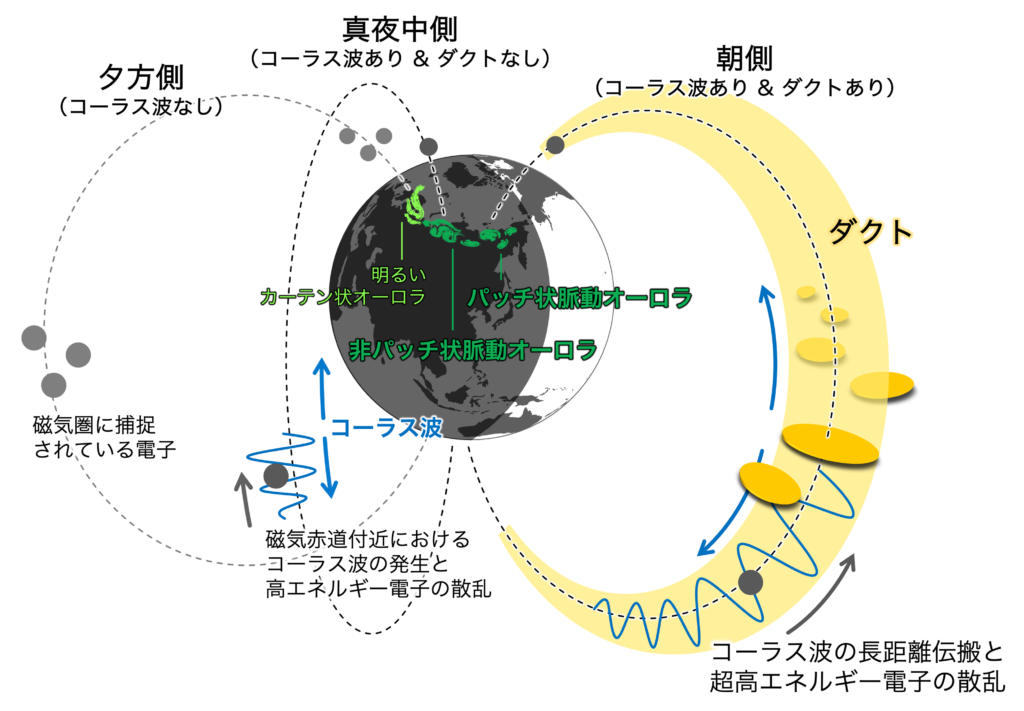
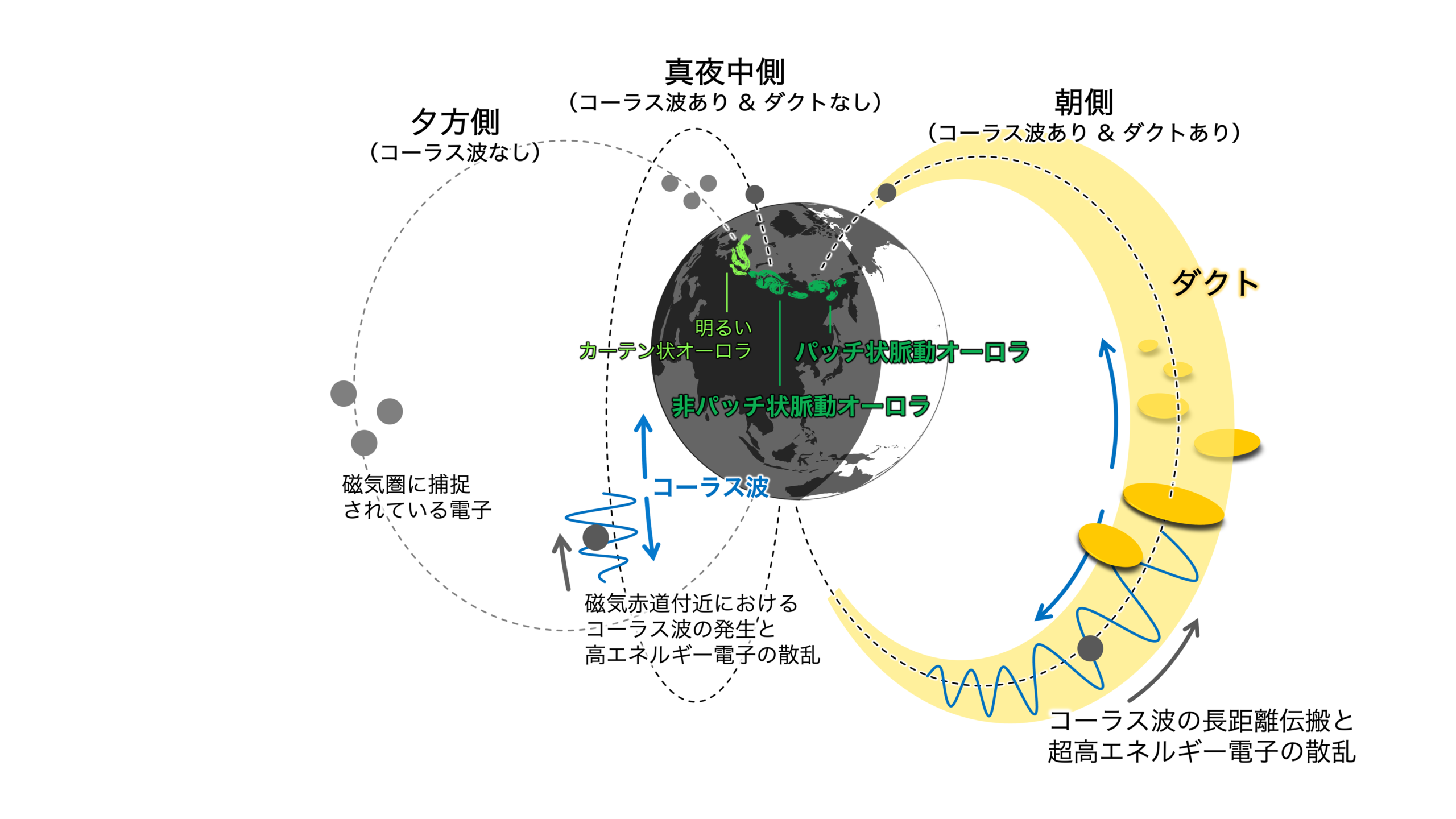
Figure 1: Overview of the model proposed in previous studies and examined in this study
Before midnight (on the dusk side), chorus waves occur only infrequently. Around midnight, chorus waves begin to occur, and pulsating auroras also appear. After midnight (on the dawn side), long-distance chorus-wave propagation through ducts, the scattering of ultra-high-energy electrons, and patchy pulsating auroras all occur more frequently.
【Glossary】
*1 Pulsating auroras
Auroras that repeatedly brighten and fade at intervals ranging from several to several tens of seconds. They are broadly classified into patchy and non-patchy types; the former have well-defined patch structures, whereas the latter have irregular shapes. Previous studies have shown that patchy pulsating auroras occur more frequently at later times (closer to dawn) than non-patchy pulsating auroras.
*2 “Arase” (ERG: Exploration of energization and Radiation in Geospace)
A Japanese geospace exploration satellite designed to elucidate the acceleration and loss processes of high-energy electrons that form the radiation belts in Earth’s magnetosphere.
*3 Chorus waves
Natural electromagnetic plasma waves that occur near the equatorial plane of the magnetosphere, a region of space surrounding Earth. They play a role in scattering high-energy electrons, causing some of them to precipitate into Earth’s atmosphere.
*4 Ducts
Tubular structures in the magnetosphere in which the electron density is significantly higher or lower than that of the surrounding region. Like optical fibers, they are thought to confine waves within the ducts through electron-density differences between the inside and outside of the ducts (corresponding to differences in refractive index), thereby promoting long-distance propagation.
Click here to see the press release【Japanese only】
Journal : Journal of Geophysical Research: Space Physics
Researchers' Information: Yoshiya Kasahara
Shoya Matsuda
Related Information
Graduate School of Natural Science and Technology, Kanazawa University
 PAGE TOP