
Rihiro Saegusa Photo
Research NEWS

How the Brain’s Master Clock Generates Precise Daily Rhythms: A Fundamental Mechanism Revealed

Faculty of Medicine, Institute of Medical, Pharmaceutical and Health Sciences, Professor
三枝 理博MIEDA, Michihiro

A research group led by Wang Mohan, a fourth-year doctoral student in the Division of Medicine, Graduate School of Medical Sciences, Kanazawa University, and Professor Mieda Michihiro of Faculty of Medicine, Institute of Medical, Pharmaceutical and Health Sciences and Health Sciences, has elucidated the basic mechanism by which the neural network of the suprachiasmatic nucleus, the center of the body's internal clock, generates robust circadian rhythms.

In mammals, including humans, sleep, behavior, body temperature, and hormone secretion are regulated in an approximately 24-hour cycle in response to changes in day and night. This daily rhythm is called the circadian rhythm. The center of the body clock that generates circadian rhythms is located in the suprachiasmatic nucleus in the hypothalamus of the brain. The suprachiasmatic nucleus is a neural network consisting of many different types of neurons, but the detailed mechanism of how it generates a strong and stable circadian rhythm has not been fully understood.

In this study, it was revealed that in the suprachiasmatic nucleus, neurons producing vasopressin (*1) and neurons producing vasoactive intestinal peptide (*2) form feedback circuits that influence each other, and that this cell-to-cell interaction generates a stable circadian rhythm with an approximately 24-hour cycle.

When the body's internal clock does not match the changes in day and night due to travel with time differences, shift work, or circadian rhythm sleep-wake disorder (*3), it can cause a variety of problems in daily life. Therefore, understanding how circadian rhythms are created is extremely important for maintaining good health. The results of this research are expected to lead to the future prevention and treatment of various diseases and health problems caused by disrupted body clocks, such as sleep disorders, autonomic nervous system disorders, and metabolic syndrome.

The results of this research were published in the online edition of the British scientific journal "Nature Communications" on January 5, 2026.


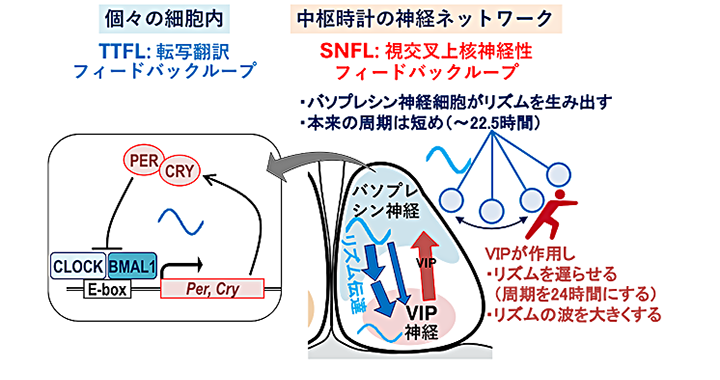
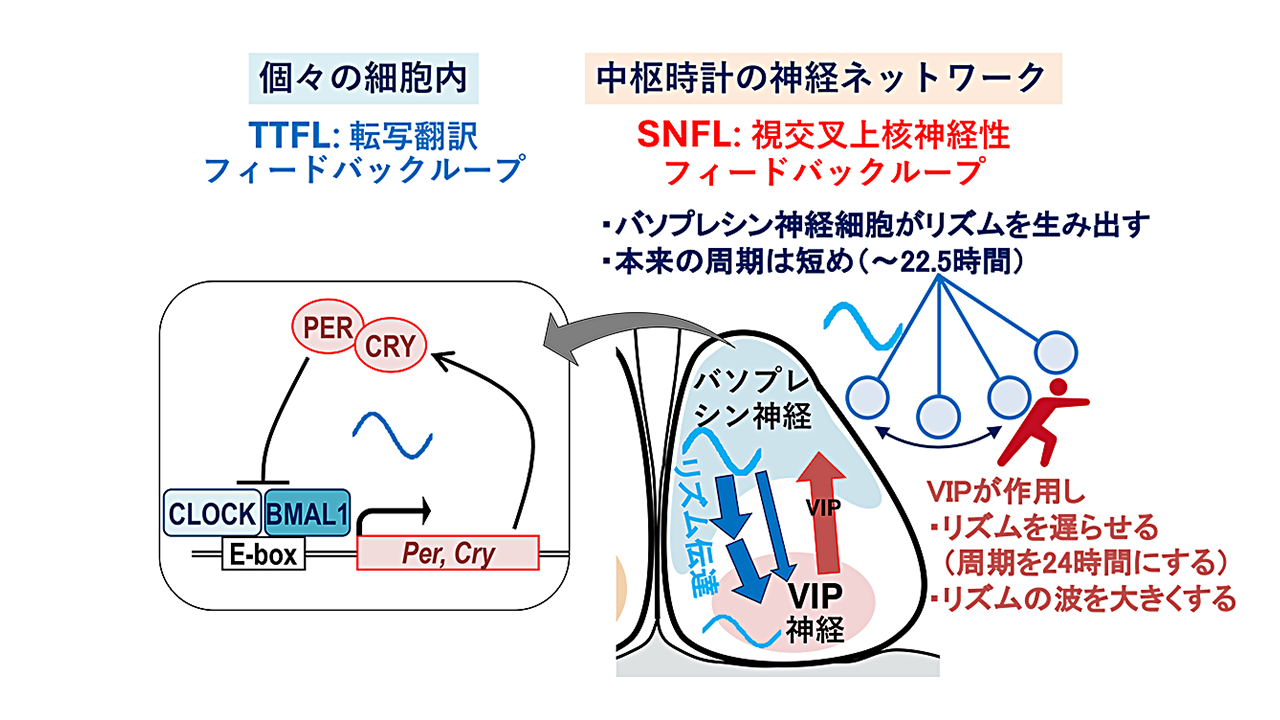
Figure: Feedback neural circuits in the suprachiasmatic nucleus produce a strong and stable circadian rhythm
The suprachiasmatic nucleus, the brain’s master clock, is a neural network of approximately 20,000 neurons, each of which has an intracellular clock molecular mechanism (TTFL) with clock genes. TTFLs are necessary, but not sufficient, for the suprachiasmatic nucleus to function as a central clock. In addition to the intracellular mechanisms, vasopressin-producing neurons and VIP-producing neurons influence each other (bidirectional communication via the feedback neural circuit SNFL) to produce a robust and stable circadian rhythm with an approximately 24-hour cycle.


【Glossary】
*1  Vasopressin
A peptide consisting of 9 amino acids. It is also called arginine vasopressin (AVP) because the eighth amino acid of vasopressin in most mammals, including humans, is arginine. It is well known for its function as an antidiuretic hormone, which is released from the hypothalamus to prevent diuresis by increasing water reabsorption in the kidneys. However, vasopressin produced by the suprachiasmatic nucleus does not have a role as an antidiuretic hormone, and the details of its role are unknown.

*2  Vasoactive intestinal peptide (VIP)
A peptide hormone composed of 28 amino acid residues. It was discovered as a hormone that widens blood vessels and increases blood volume. It is produced in the gastrointestinal tract, pancreas, and areas of the brain including the suprachiasmatic nucleus of the hypothalamus. In the suprachiasmatic nucleus, vasoactive intestinal peptide-positive cells receive a direct projection from the retina and function to regulate the timing of circadian rhythms by ambient light. Deletion of this peptide has also been shown to impair circadian rhythms.

*3  Circadian rhythm sleep-wake disorder
3 Circadian Rhythm Sleep-Wake Disorder is a generic term for sleep disorders in which the cycle and timing of sleep and wakefulness caused by the body's internal clock deviates from the desirable time zone for social life. There are several main types: the jet‑lag type, in which physical and mental discomfort occurs due to flights across time zones with a difference of four to five hours or more; the shift‑work type, caused by working in rotating shifts; the advanced sleep phase type, in which a person wakes up too early; the delayed sleep phase type, in which the time one sleeps shifts later; and the free‑running type, in which the sleep–wake cycle drifts away from the 24‑hour rhythm.


Click here to see the press release【Japanese only】

Journal: Nature Communications

Researcher Information : Michihiro Mieda

Related Information

College of Medical, Pharmaceutical and Health Sciences, Kanazawa University  (Japanese page only) : https://www.kanazawa-u.ac.jp/collegeschool/30_mph/

Graduate School of Medical Sciences / School of Medicine, College of Medical, Pharmaceutical and Health Sciences, Kanazawa University : https://www.med.kanazawa-u.ac.jp/EN/index.html


FacebookPAGE TOP