




An Inevitable Path: Shaped by an Encounter with Computers
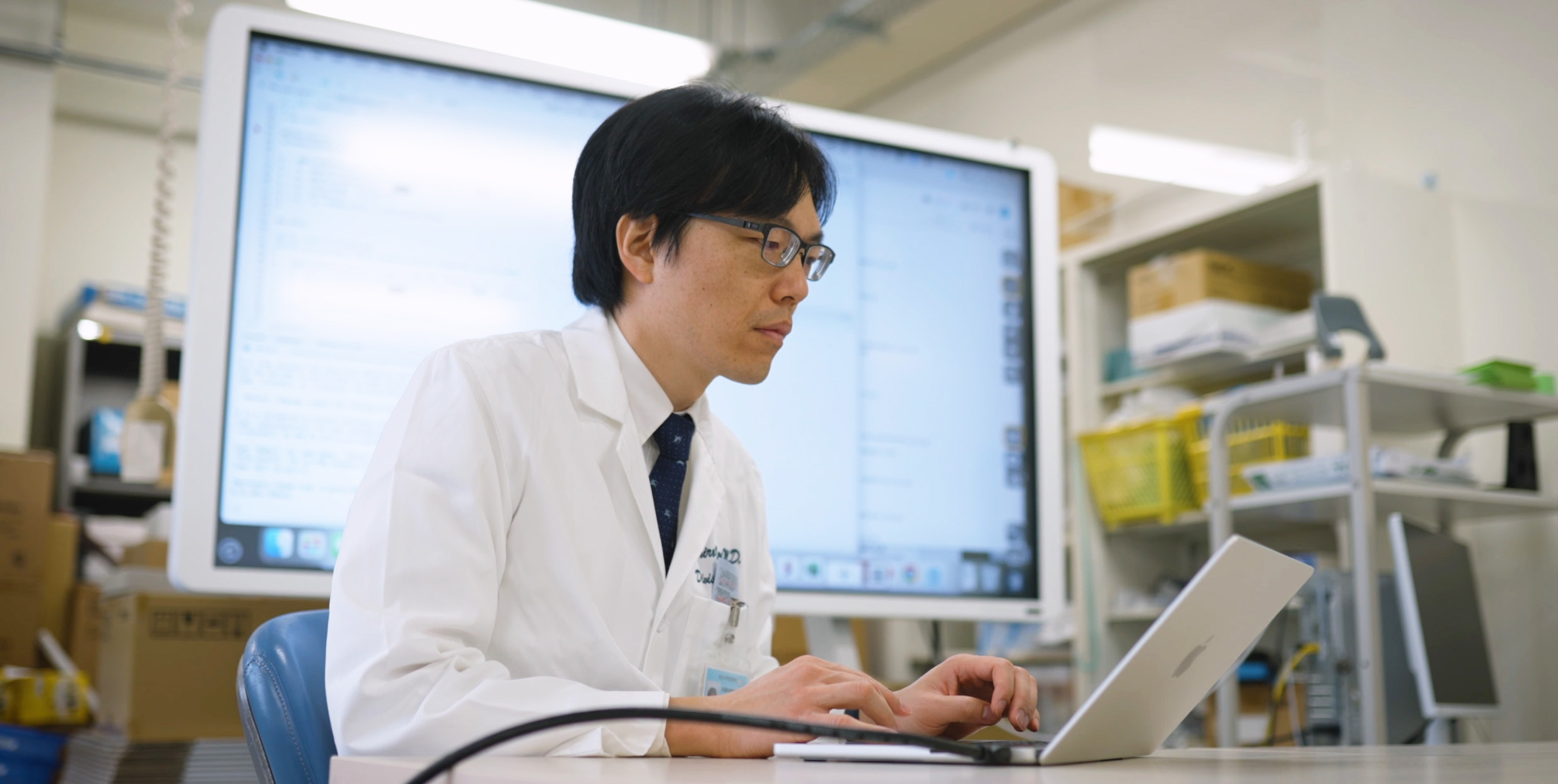
At the Division of Convergence Science, Professor Akihiro Nomura focuses on integrating digital technologies with medicine. He isn’t just a leading researcher; he is also an clinical cardiologist, providing outpatient care on the clinical frontline. Moving back and forth between patient care and cutting-edge research, one tool is always by his side: the computer. His journey with computers began early, around the fourth grade. Looking back with a smile, he recalls: “I was the kind of kid who loved creating computer games, basically what we now call programming.” That childhood hobby eventually became a decisive factor in shaping his research career.
Inspired by his father who was also a physician, Professor Nomura chose the path of medicine. While he finds meaning in caring for his patients every day, he couldn't ignore a frustrating reality: too many diseases remain insufficiently understood. Driven by a strong conviction, he entered graduate school. He firmly believed that: “Basic research is absolutely essential for developing new treatments.” There, while studying the genetics of heart failure and cardiomyopathy, he realized the immense power of data analysis and statistics. This experience sparked a new passion for computational science. Explaining his motivation, he says: “I was fascinated by the idea of using computational approaches to uncover the mechanisms of diseases and unexplained biological phenomena.”
During his graduate studies, the medical field experienced a technological revolution. Researchers suddenly had the tools to handle vast amounts of genetic data, making computational science and machine learning more important than ever.
For Professor Nomura, this was the perfect convergence of his two worlds: his clinical expertise in cardiology and his lifelong love for computers. Reflecting on this turning point, he notes: “It was incredibly fascinating and truly enjoyable to see how these elements came together in my work.”
Translational Research — Bridging Bench and Bedside
Today, Professor Nomura is engaged in pioneering work that fuses cardiology with cutting-edge digital technology. For him, the ultimate goal is always the patient. He explains: “What matters to me isn't just conducting research for its own sake. It’s about making sure our findings are actually implemented in real clinical settings.” His commitment lies in bringing scientific innovation directly to patient care. This approach, which connects basic medical science with clinical practice, is known as translational research, and it forms the core framework of his work.
His current focus within this field is “digital medicine.” By leveraging smartphones, AI, and other advanced technologies, he collects vast amounts of data from genetics and physiology to everyday lifestyle habits. Analyzing this information through the lenses of both basic and clinical medicine, he aims to deepen our understanding of diseases, ultimately contributing to better treatment and prevention.
But his vision goes beyond the hospital walls. Recognizing the true potential of digital technology, he notes: “I envision a form of healthcare that seamlessly integrates into everyday life, extending far beyond the hospital environment.” After all, gathering data is not the final goal. What truly matters is what that data reveals, and the scientific meaning derived from it. Moving seamlessly back and forth between foundational theory and clinical practice…this is the true hallmark of Professor Nomura’s research style.
Toward a Future: Digital Technologies as a Trusted Partner
Looking ahead, Professor Nomura’s ultimate aspiration is to realize a new paradigm in healthcare. He calls it: “Human–digital symbiosis in clinical medicine.” By “symbiosis,” he means a relationship where humans remain the primary decision-makers, while AI and digital tools act as supportive partners, enhancing our judgment and actions. To illustrate this profound concept, he points to our very own evolutionary history: “Long ago, mitochondria and human ancestors entered into a symbiotic relationship, which allowed us to evolve and thrive as living organisms.” Humanity evolved by incorporating the ancestors of mitochondria, which was once independent organisms, into our cells. This integration enabled us to produce energy far more efficiently. Much like modern computers and artificial intelligence, mitochondria do not replace human decision-making. Yet, they play a crucial, unseen role in sustaining life at its very foundation. Similarly, Professor Nomura envisions digital technologies as internal partners that quietly support and expand human capabilities from within. In medicine, he emphasizes that AI should never take over as the primary decision-maker. Instead, its essential role is to serve as a trusted partner, empowering both physicians and patients to make better-informed choices.
The true reward of this vision is seeing it reach the patient. Reflecting on a recent milestone, he shares with a smile:
“I was truly delighted when a digital medical device I helped develop was finally released, and I could actually prescribe it with my own hands during outpatient care.” That exact moment, when research outcomes come alive in real clinical practice, is what fuels his motivation, driving him ever forward toward the next stage of discovery.
(Science Writer: Yuko Mitera, English Translation:Md Abul Kalam SIDDIKE)
 PAGE TOP