




On September 2, the International Center for Research and Education of Japan Studies, Kanazawa University and the Graduate School of Human and Socio-Environmental Studies held the symposium “Community, Mobility, and Cultural Representation: Interdisciplinary Perspectives from Japan and Türkiye” at the Step Hall of the Biomass Green Innovation Center (BGIC) on Kakuma Campus.
The symposium was planned and organized by Associate Professor Sen Raj Lakhi of the Center. Centered on the three themes of “community,” “mobility,” and “cultural representation,” the symposium aimed to share research findings from diverse fields, including linguistics, anthropology, history, social movement studies, and comparative mythology, focusing on Japan and Türkiye, and to explore new possibilities for Japanese studies and area studies through interdisciplinary discussion. On the day of the event, graduate students and faculty members from Kanazawa University, researchers from other universities and overseas partner institutions, and members of the general public gathered and engaged in lively discussions.
At the opening of the symposium, Professor Haruyuki Kojima, Dean of the Graduate School of Human and Socio-Environmental Studies and Professor of the Faculty of Humanities, Institute of Human and Social Sciences, delivered opening remarks.
In Part I, the “Graduate Student Research Presentation Session,” Associate Professor Urara Tamura of the Faculty of Regional Development Studies, Institute of Human and Social Sciences, and Associate Professor Sen Raj Lakhi served as moderators. Kanazawa University graduate students Nonoko Morita, Hina Shigi, and Rioko Kinseki presented their research findings. Following the presentations, a question-and-answer session and commentary were held, allowing participants to exchange perspectives across different regions and research subjects.
In Part II, the “Research Presentation Session,” Associate Professor Aida Mammadova of the Center and Associate Professor Melek Celik of Canakkale Onsekiz Mart University, one of Kanazawa University's partner institutions in Türkiye, served as moderators. Kanazawa University graduate student Seira Harada and Associate Professor Tamura delivered research presentations, leading to multifaceted discussions on the themes of education, community, and mobility through their respective research.
In Part III, the “Research Presentation and Lecture Session,” Associate Professor Sen Raj Lakhi served as moderator. First, Rino Nakashima, a graduate student at Hitotsubashi University, presented a report on the historical development of social movements concerning sexual minorities in Türkiye. Next, Associate Professor Melek Celik compared representations of deities, serpents, marriage, and women in Turkish and Japanese myths and folk narratives, discussing similarities and differences in mythological imagination and worldviews between the two cultures.
During the general discussion following the presentations, numerous questions were raised by audience members, resulting in active exchanges of views from a comparative perspective on Japan and Türkiye. The lecture by a researcher invited from a partner institution provided an opportunity to further deepen academic exchange between Kanazawa University and Türkiye.
At the closing of the symposium, Professor Hiroshi Yamamoto, Director of the Center, delivered closing remarks. He reflected on the significance of researchers from different academic disciplines, generations, institutions, and countries engaging in earnest discussions using Japanese as a common language of scholarship, and expressed his hope that the symposium would serve as a starting point for new research exchange and collaboration connecting Japan and Türkiye.
The symposium brought together graduate students, early-career researchers, faculty members, and researchers from overseas partner institutions, providing a venue for interdisciplinary engagement across diverse research topics, including community, mobility, gender, and cultural representation. It also provided a valuable opportunity to reexamine Japan from interdisciplinary and international perspectives, promote exchange between researchers in Japan and Türkiye, and contribute to future educational and research collaboration.
The presentation titles and presenters for each session were as follows.
Part I: “Graduate Student Research Presentation Session”
“Marriage and Social Relationships in Local Communities in Japan”
Nonoko Morita Division of Humanities, Graduate School of Human and Socio-Environmental Studies
“Refugee Reception Systems in Poland and Perceptions of the Language of the Host Society”
Hina Shigi Division of International Studies, Graduate School of Human and Socio-Environmental Studies
“Representations of the ‘Okami’ in the Hokuriku Region”
Rioko Kinseki Division of Humanities, Graduate School of Human and Socio-Environmental Studies
Part II: “Research Presentation Session”
“A Comparative Study of Learning Opportunities for University Students in UNESCO-Designated Areas: Focusing on BR, GGP, and WHS in Türkiye”
Seira Harada Division of Human and Socio-Environmental Studies, Graduate School of Human and Socio-Environmental Studies
“An Anthropological Study of the Representation and Practice of ‘Mobility’ Among Turkish Nomads”
Associate Professor Urara Tamura Faculty of Regional Development Studies, Institute of Human and Social Sciences,
Part III: “Research Presentation and Lecture Session”
“The Historical Development of the Queer Movement in Türkiye”
Rino Nakashima Graduate Student, Hitotsubashi University
“A Comparative Study of Deities, Serpents, Marriage, and Representations of Women in Turkish and Japanese Mythology”
Associate Professor Melek Celik Canakkale Onsekiz Mart University
-
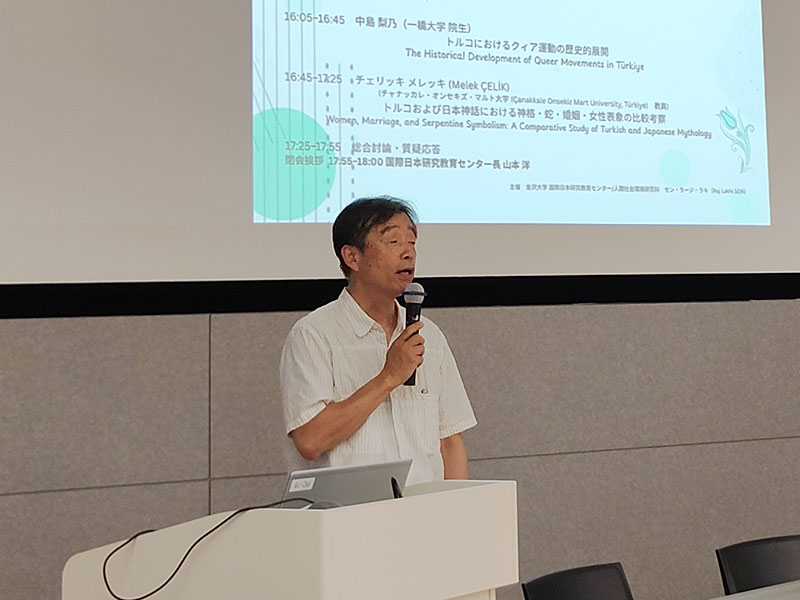 Dean Kojima delivering the opening remarks
-
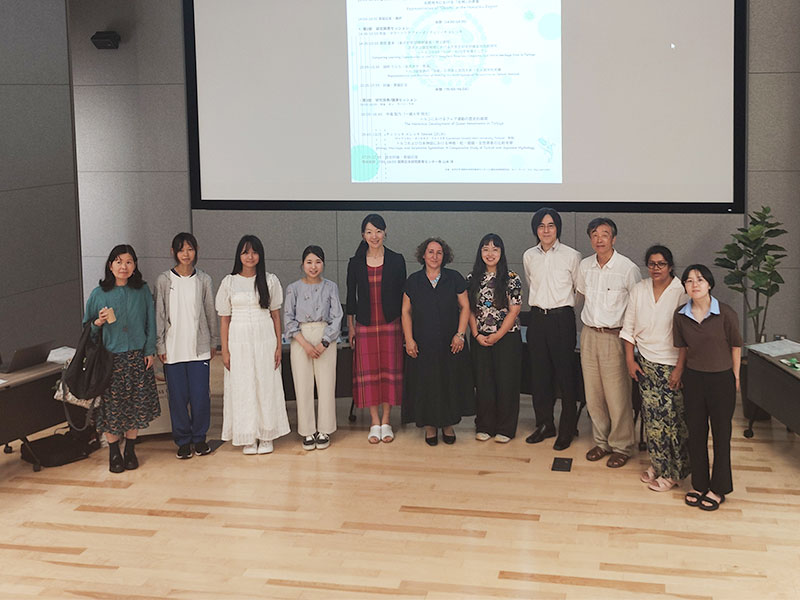 Group photograph of symposium participants
 PAGE TOP