
Associate Professor Kenjin Aoki, Faculty of Regional Development Studies Institute of Human and Social Sciences Kanazawa University, a member of a research team consisting of Hiroshima University, Chiba Prefectural Museum, Fukuoka University of Education, Hyogo University of Education, Yamaguchi University, Okayama University, and Kanazawa University, conducted precise measurements of coastal uplift caused by the 2024 Noto Peninsula earthquake, and clarified the location and shape of submarine active faults distributed near the coast from seafloor topographic data and other data. We have also clarified the location and shape of submarine active faults distributed near the coast based on seafloor topographic data and other data. In particular, Associate Professor Kento Aoki provided information on the field survey that had been conducted since immediately after the disaster, facilitated the smooth implementation of the research team's field survey, and conducted the survey as a member of the team.
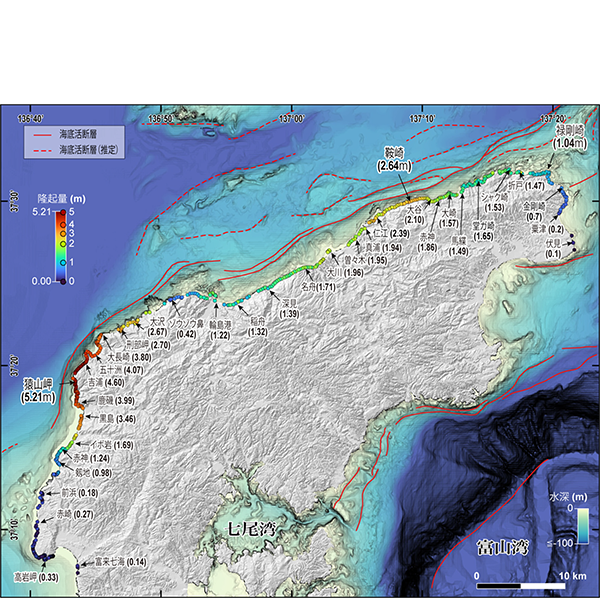
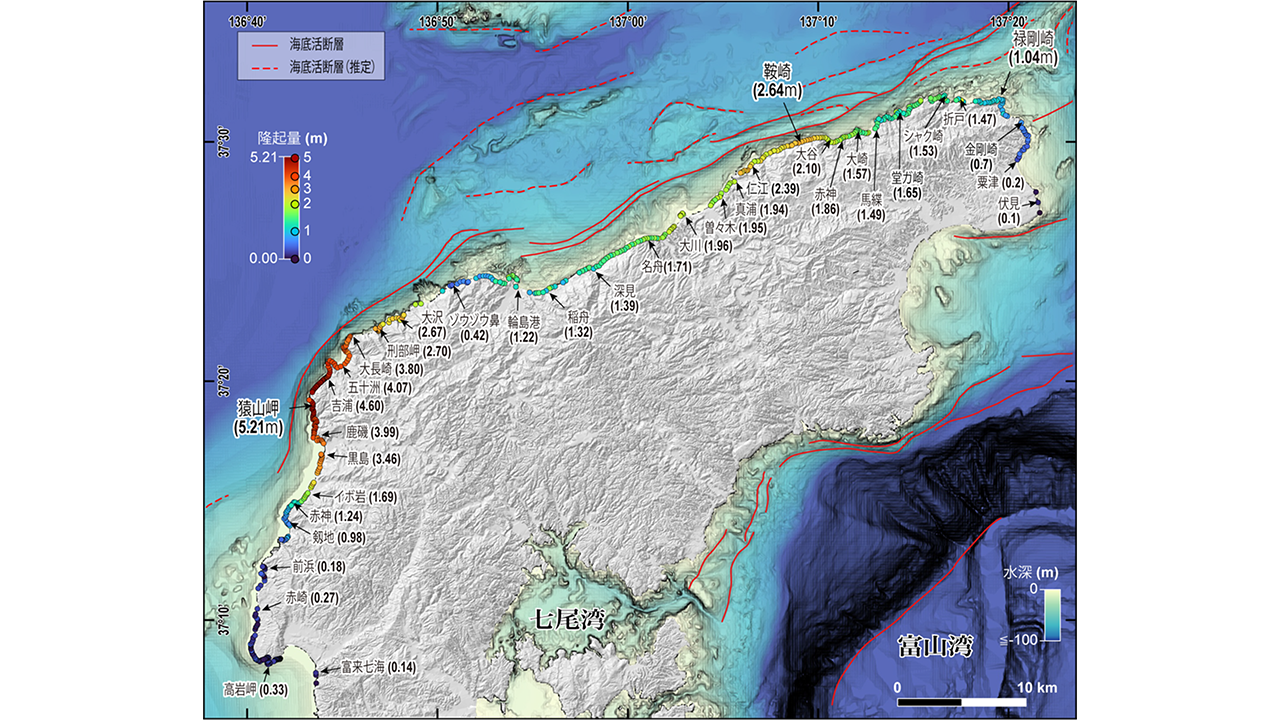
The survey revealed that the uplifted area associated with the 2024 Noto Peninsula earthquake extended approximately 100 kilometers, making it one of the longest in the world. The uplift was measured at 510 points along the coastline and ranged from 0.1 to 5.2 meters, with large uplifts observed near Cape Saruyama at the northwestern end and around Kurasaki on the northern coast.
On the other hand, analysis of bathymetry and stratigraphic data revealed that the active fault that caused the uplift extended continuously almost parallel to the coastline. The locations where the uplift was particularly large were concentrated in the land area adjacent to the fault line, and it was confirmed that the distribution of uplift can be explained by the activity of a reverse fault tilting to the south.
Previously, submarine active faults very close to the coastline were difficult to survey and had not received sufficient attention. In this study, we succeeded in capturing the movement of these faults clearly for the first time by combining analysis of seafloor topographic data and topographic surveys on land.
The results of this research have been published in the international journal "Geomorphology".

Figure: Distribution of uplift and submarine active faults for the 2024 Noto Peninsula earthquake
【Glossary】
*Coastal uplift
A phenomenon in which the ground is raised by an earthquake. On the coast, the uplift can be confirmed by the appearance of traces (wave marks, seaweed attachment marks, etc.) created by the sea surface before the earthquake, which appear higher than the sea surface after the earthquake. By comparing the difference in height between these traces and the sea surface, which is considered to be immobile, the amount of uplift caused by the earthquake can be determined.
*Submarine Active Faults
A fault that lies under the sea floor, has moved many times in the past, and is expected to remain active in the future. When distributed near the coast, the fault plane may extend beneath the land, which can cause strong shaking as well as tsunamis in the event of an earthquake.
Click here to see the press release【Japanese only】
Journal : geomorphology
Researcher's Information: Tatsuto Aoki
Related Information
Kanazawa University College of Human and Social Sciences School of Regional Development Studies: https://chisou.w3.kanazawa-u.ac.jp/
Kanazawa University Graduate School of Natural Science and Technology: https://www.nst.kanazawa-u.ac.jp/