

The Future Vision of Kanazawa University “Kokorozashi” Version UP 2026
The Noto Peninsula Earthquake of January 1, 2024, and the Noto heavy rain of September 2024 caused extensive damage in various areas, especially on the Noto Peninsula. We would like to express our deepest sympathies to all those affected by these disasters. As a comprehensive university located in Ishikawa Prefecture, we will continue to make every effort toward the earliest possible restoration, recovery, and reconstruction of the affected areas.
In the immediate aftermath, Kanazawa University mobilized all of its capabilities to respond to the initial stages of these disasters. At the end of January 2024, we established the Noto Resilience and Revitalization Center, creating a framework to stand alongside the affected areas and support earthquake recovery from a medium- to long-term perspective, with the aim of contributing to “the development of culturally rich communities and towns that are resistant to earthquakes and other disasters, safe, secure, and comfortable for everyone to live in, as well as to the development of human resources.” Under an unwavering philosophy and aspiration to “contribute to society through ‘Future-oriented Intelligence’ based on an All Kanazawa University approach,” we aim to bring together our Future-oriented Intelligence, create new value in Noto, demonstrate the society of the future, and share this vision across Japan and around the world. Through these efforts, we will remain committed, as an academic organization, to supporting recovery from the earthquake.
Formulating the Future Vision of Kanazawa University, “Kokorozashi”
Kanazawa University was founded in 1862 as Kaga Domain's Hikoso Vaccination Center. We are a comprehensive university that has inherited the history and traditions of our predecessor schools, including the Fourth Higher School, Ishikawa Normal School, Ishikawa Youth Normal School, Kanazawa Higher Normal School, Kanazawa Medical College, and Kanazawa Technical College.
After I was appointed President of Kanazawa University in April 2022, I formulated an unwavering vision for the future of Kanazawa University, “Kokorozashi” (Aspiration). This built on the history established by our predecessors and our basic philosophy of being “a research university dedicated to education, while opening up its doors to both local and global society,” as stated in the Charter of Kanazawa University. I presented “Kokorozashi” both within the university and to society at large in May of the same year.
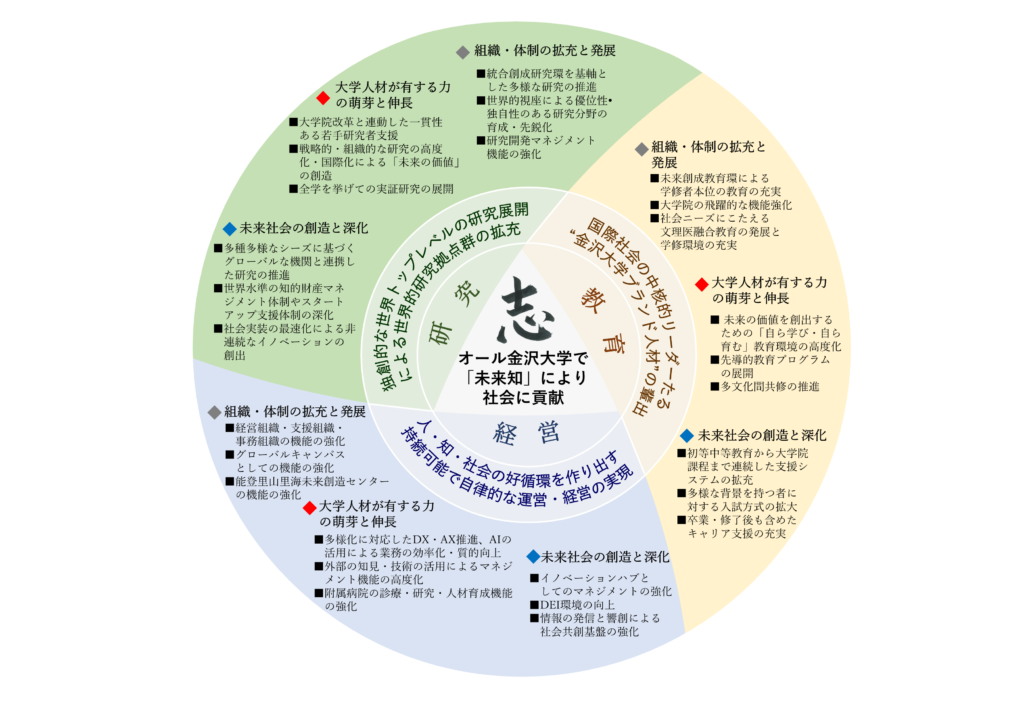
Our goal is to contribute to society through “Future-oriented Intelligence,” which means exploring and overcoming future issues, as well as solving current issues, by utilizing two perspectives – local and global.
With this in mind, our research, education, and administrative ideals are as follows: Research: Enhance ourselves as global research bases through the development of innovative, world-class research. Education: Produce core leaders of international society as “Kanazawa University Graduates.” Administration: Realize sustainable and autonomous administration that creates a virtuous cycle of people, knowledge, and society.
These three ideals are closely related to each other. Research and education form a positive loop with a mutually positive impact. At the same time, this is supported by solid administration and management. The vision of Kanazawa University is to integrate these three functions and contribute to society through “Future-oriented Intelligence.”
Building on our basic philosophy, we clarified our future vision, “Kokorozashi,” and set out our ideals for research, education, and administration. Toward this vision, we established missions defining what Kanazawa University should do now, and individual action plans specifying what it will do now.
Initiatives since the Formulation of “Kokorozashi”
About four years have passed since we announced the future vision of Kanazawa University, “Kokorozashi.” To realize it, students, faculty, and staff have transcended their respective positions and worked together with mutual respect and collaboration through an All Kanazawa University approach. These efforts are bearing fruit in research, education, and administration alike.
To enhance ourselves as global research bases through the development of innovative, world-class research, we are implementing various initiatives under the Interfaculty Institute for Frontier Science, leveraging close collaboration among the humanities, sciences, and medicine to accelerate our contributions to society through Future-oriented Intelligence driven by basic, applied, and social empirical research. In FY2023, Kanazawa University was selected by the Ministry of Education, Culture, Sports, Science and Technology (MEXT) for the “Program for Forming Japan's Peak Research Universities (J-PEAKS),” and is now giving concrete shape to world-class bases for discontinuous innovation through the fusion of the humanities, sciences, and medicine. Vision Incubate Co., Ltd., a venture capital company in which we have a 100% stake, began operations. In FY2025, the MIRAICHI Research Center, the core of our empirical research, also began full-scale operation, completing a seamless support system that spans basic research, interdisciplinary research across the humanities and social sciences, natural sciences, and medicine, empirical research, and social implementation. In FY2026, we were selected for the “Empowering Research Platform for Outstanding Creativity & Harmonization (EPOCH)”, under which we will build a model for renewing research infrastructure and extend it across Japan and around the world. Through initiatives such as our International Labs and EXPERT-J, we are building international research communities and advancing institution-wide international collaborative research. As a global research university, we will further contribute to society by strengthening our research capabilities and advancing the social implementation of our research.
To produce core leaders of international society as “Kanazawa University Graduates,” we are promoting an integrated education and support system from primary and secondary education through graduate school under the Interfaculty Institute for Future Education, centered on KUGS (Kanazawa University Global Standards). In FY2023, we were selected for the Science and Technology Challenge Program for Next Generation, and we now offer a long-term, seamless development program for elementary, junior high, high school, and technical college students. In the same year, the G7 Education Ministers' Meeting Excursion in Toyama and Kanazawa was held at our Kakuma Campus. Ministers from G7 countries and representatives of international organizations visited our university and talked directly with university and school students and teachers. It was a very valuable opportunity. In FY2024, we were selected for the “Multicultural Campus Project Toward Social Impact.” We are advancing our internationalization toward becoming a university where the international is part of everyday life, and everyday life is international. Led by the International Center for Japan Studies and Education, we are developing multicultural co-learning centered on Japanese language education, traditional culture, and related fields. In FY2025, we were selected for the “Future-Leading and Advanced Graduate-schools (FLAGs)” program, and under the Organization for Excellence in Graduate Education, we are developing doctoral-level talent capable of creating new value. We are also promoting the initiatives of the Kanazawa University Strategic Project for Development of Doctoral Students and Research Promotion (HaKaSe+) so that more students decide to pursue graduate studies and engage in doctoral research.
To realize sustainable and autonomous administration that creates a virtuous cycle of people, knowledge, and society, our faculty and staff are working together to promote pioneering and strategic reforms. In FY2022, we were selected for the National University Management Reform Promotion Project, through which we have built a foundation for vigorously investing in people and advancing projects toward our ideal of being a global research university with multiple world-class research bases. In addition, under the coordination of the Hokuriku Economic Federation, we will further enhance the HOKURIKU Open Platform for Co-creating the Future, which is jointly operated by four national universities in the Hokuriku region, including our university. Through this platform, we will accelerate open innovation through industry-academia-government collaboration. At the same time, as a foundation for sustainable management, we are ensuring thorough compliance and strengthening our risk management framework. We will address issues such as research and educational integrity and information security through a university-wide system.
Toward creative reconstruction following the Noto Peninsula Earthquake, we are developing the MIRAICHI MITSUKE Project, which is creating an off-grid community that will shape the future of Japan with the recovery of Noto as its starting point. We will build a model for an autonomous, decentralized community in this region, which is at the forefront of challenges such as a declining birthrate, an aging population, and depopulation, and extend it to other regions. In addition, in FY2025, we launched the Disaster Prevention and Revitalization Program to develop human resources who can contribute to recovery and reconstruction as well as disaster prevention and mitigation in Japan and abroad.
These achievements will become stepping stones for Kanazawa University to achieve its ideals. To pursue continuous reform toward realizing “Kokorozashi,” we have firmly established a PDCA cycle consisting of formulating “Kokorozashi,” implementing missions and actions, conducting annual self-inspection and evaluation, and making revisions based on the results. This revision has been made with a view to the Fifth Medium-Term Goals and Medium-Term Plan. Toward realizing our vision for 2040, “a university that continues to create new value by generating discontinuous innovation through Future-oriented Intelligence,” all members of the University will devote themselves to research and education as a research university.

(Reference) Previous university reform policies
- The Future Vision of Kanazawa University “Kokorozashi” Version UP 2024
- The Future Vision of Kanazawa University “Kokorozashi” Version UP 2024 (English version)
- The Future Vision of Kanazawa University “Kokorozashi” Version UP 2024-milestone-[Detailed version, for internal use only]
- The Future Vision of Kanazawa University “Kokorozashi”
- The Future Vision of Kanazawa University “Kokorozashi” (English version)
- The Future Vision of Kanazawa University “Kokorozashi” 3 points [PR Magazine Acanthus No.50 PDF].
- The Future Vision of Kanazawa University “Kokorozashi” -milestone- [Detailed version, for internal use only].
- YAMAZAKI Plan 2020 Next Stage
- New YAMZAKI Plan 2018
 PAGE TOP