




A research group led by Professor Kenjiro Ono, Faculty of Medicine, Institute of Medical, Pharmaceutical and Health Sciences, Kanazawa University, analyzed data from 100 lecanemab-treated (*1) patients with early Alzheimer’s disease (*2) at Kanazawa University Hospital. They evaluated the biomarkers including cerebrospinal fluid phosphorylated tau 181 (CSF-ptau181) (*3) at baseline that could predict cognitive decline and the occurrence of amyloid-related imaging abnormalities (ARIA)(*4). This study revealed that the CSF-ptau181 level at baseline was associated with cognitive decline and ARIA occurrence during lecanemab administration.
Lecanemab is approved for individuals with mild cognitive impairment or mild dementia due to Alzheimer’s disease, side effect such as ARIA has been issues. CSF‑ptau181 is a tau biomarker known to increase in association with tau accumulation in the brains of patients with Alzheimer’s disease. This study suggest that lecanemab may be both safer and more effective in patients at an earlier stage of the disease, when tau accumulation in the brain is still relatively limited.
Based on these findings, CSF‑ptau181 measurement is expected to support the prediction of therapeutic response to anti‑amyloid antibody treatments and to facilitate stratification of patients by their risk of adverse effects.
The study was published online in the international journal "Alzheimer's Research & Therapy" on November 24, 2025.
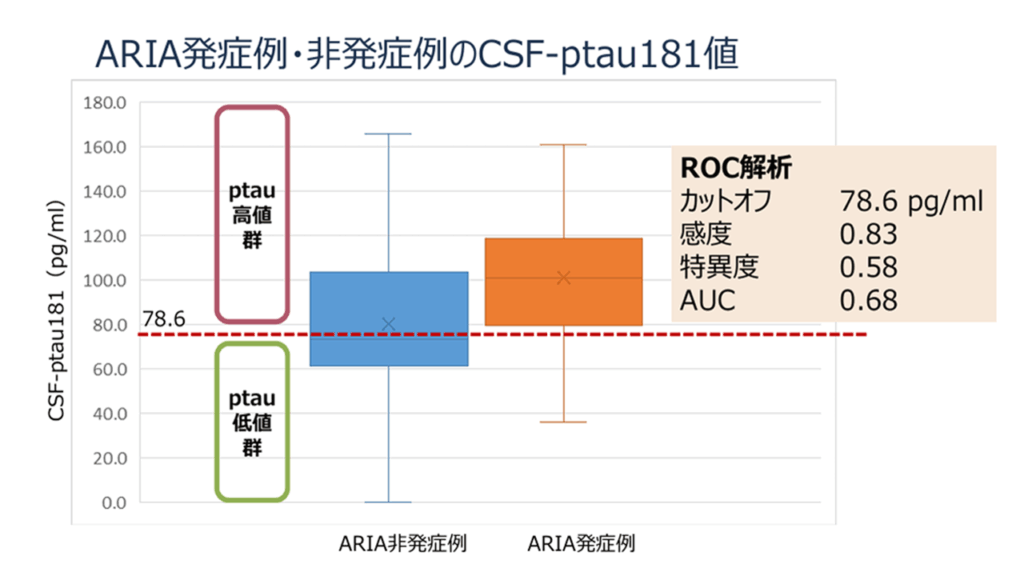
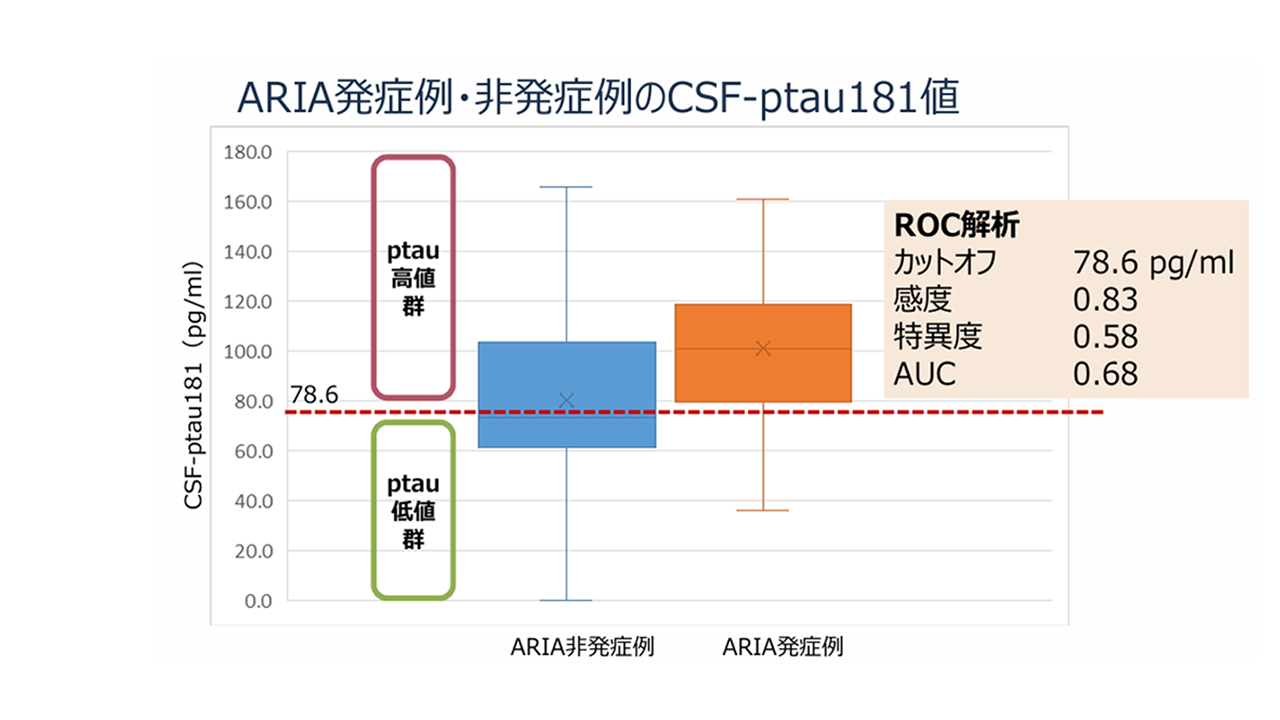
Figure : Baseline CSF-ptau181 levels in patients with and without ARIA
The baseline CSF-ptau181 levels were significantly higher in patients with ARIA than that in patients without ARIA, with sensitivity of 83%, specificity of 58%, AUC of 0.68, and optimal cut-off value of 78.6 pg/ml in ROC analysis.
Abbreviations for each group: ARIA (amyloid related imaging abnormalities), AUC (area under the curve), CSF (cerebrospinal fluid), ptau 181 ( phosphorylated tau protein 181), ROC (receiver operating characteristic)
【Glossary】
*1 Lecanemab
Lecanemab is an anti-amyloid monoclonal antibody and was released as effective treatment for patients with Alzheimer’s disease.
*2 Alzheimer’s disease
Alzheimer’s disease is a slowly progressive brain disease that gradually impairs memory and the ability to think, eventually leading to a condition called dementia, which interferes with daily life. Alzheimer’s disease In the brain of patients with dementia, there are changes such as senile plaques, which are formed by the accumulation of a substance called amyloid-β, tangles of abnormal nerve fibers (neurofibrillary changes caused by abnormal phosphorylation of tau protein), and loss of nerve cells, and these changes progress over a long period of time.
*3 CSF-ptau181
CSF‑ptau181 is an abbreviation for cerebrospinal fluid phosphorylated tau 181. Neurofibrillary tangles—one of the pathological hallmarks of Alzheimer’s disease—are thought to result from the accumulation of aggregates of excessively phosphorylated tau protein. Numerous phosphorylation sites of tau have been identified. Among them, tau phosphorylated at threonine 181 (ptau181) is particularly characteristic of Alzheimer’s disease. For this reason, CSF‑ptau181 is widely used as a biomarker for Alzheimer’s disease.
*4 ARIA
ARIA is an abbreviation for amyloid‑related imaging abnormalities. ARIA refers to abnormal MRI findings associated with amyloid‑beta antibody therapies such as lecanemab. While most cases are asymptomatic, some patients may experience symptoms including headache or confusion.
Click here to see the press release【Japanese only】
Journal: Alzheimer's Research & Therapy
Researcher Information: Kenjiro Ono
Moeko Shinohara
Related Information
Graduate School of Medical Sciences, Kanazawa University/School of Medicine, College of Medical, Pharmaceutical and Health Sciences, Kanazawa University : https://www.med.kanazawa-u.ac.jp/index.html
 PAGE TOP