


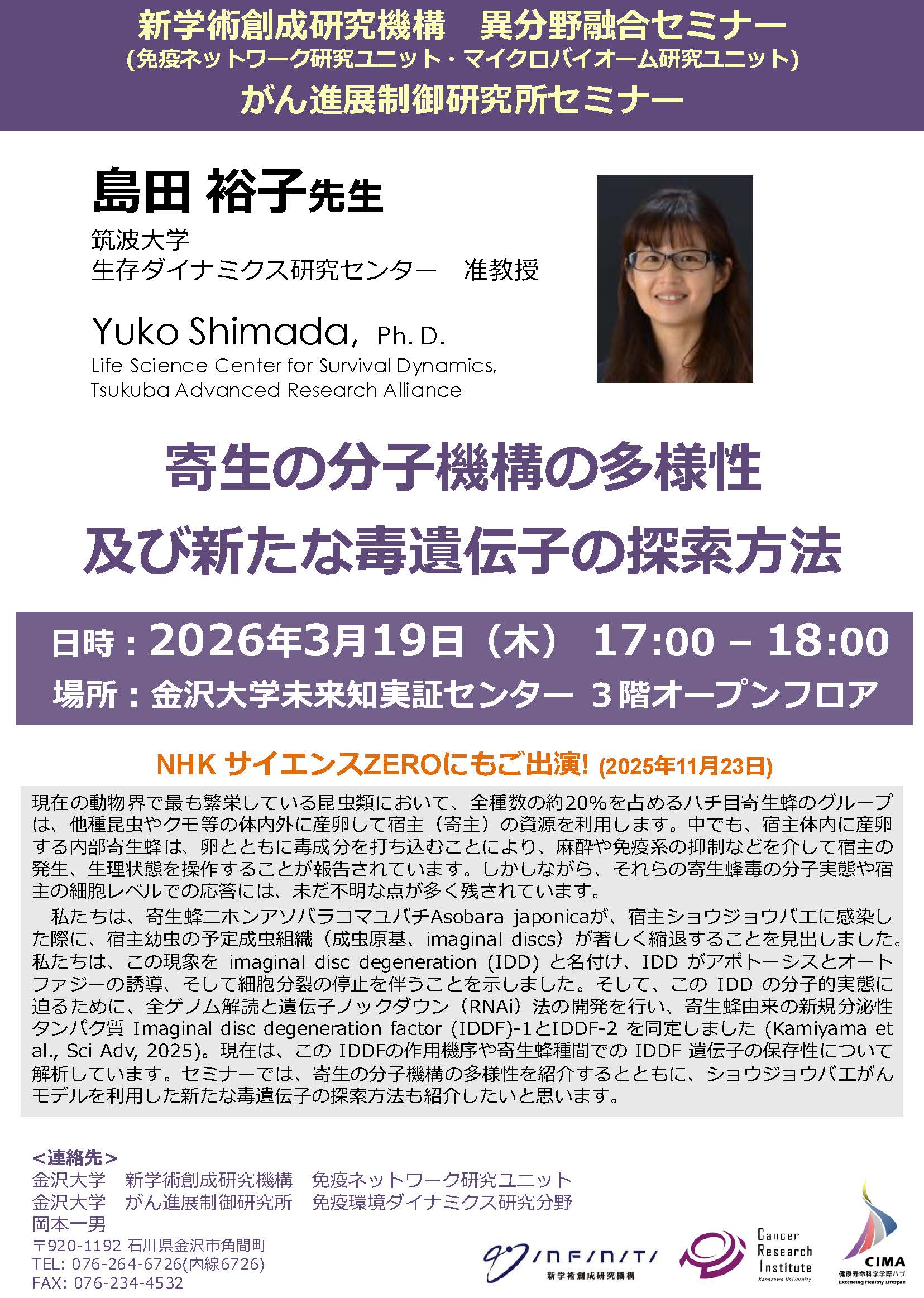
- Date and Time
- Thursday, March 19, 2026 17:00 - 18:00
- Place
- Kanazawa University Kakuma Campus MIRAICHI Research Center 3rd floor open floor
Event Details
In insects, which are the most abundant and prosperous group in the animal kingdom today, the bee parasitoid bee group, which accounts for about 20% of the total number of species, lays eggs inside and outside the bodies of other insects and spiders to take advantage of the host's (parasite's) resources. Among them, it has been reported that internal parasitoid bees, which lay eggs inside the host body, manipulate the development and physiological state of the host through anesthesia and suppression of the immune system by injecting toxic components along with the eggs. However, the molecular mechanisms of these parasitic bee venoms and their responses at the cellular level in the host remain largely unknown.
Associate Professor Yuko Shimada of theLife Science Center for Survival Dynamics, Tsukuba Advanced Research Alliance has found that the parasitic bee Asobarachmayu wasp Asobarajaponica, upon infection of the host Drosophila melanogaster, markedly shrinks the scheduled adult tissues (adult protoplasts) of the host larva. Associate Professor Shimada named this phenomenon imaginaldiscdegeneration (IDD) and showed that IDD is accompanied by apoptosis, induction of autophagy, and arrest of cell division. In order to understand the molecular basis of IDD, we have developed a whole genome sequencing and gene knockdown (RNAi) method and identified two novel secreted proteins, imaginaldiscdegenerationfactor (IDDF)-1 and IDDF-2, from parasitic bees ( Kamiyamaetal,SciAdv,2025). We are currently analyzing the mechanism of action of these IDDFs and the conservation of IDDF genes among parasitic bee species.
In the seminar, Associate Professor Shimada will introduce the diversity of molecular mechanisms of parasitism and also explain how to search for new venom genes using the Drosophila cancer model.
- How to attend
- No registration is required. Please come directly to the venue on the day of the seminar.
- attachment
Contact
Professor Kazuo Okamoto, Division of Immune Environment Dynamics, Immune Network Research Unit, Cancer Research Institute, Institute for Frontier Science Initiative, Kanazawa University
TEL: 076-264-6726
 PAGE TOP